95 Perry
Street, Suite 500
Buffalo, NY
14203-303
I am a
former Civil Engineer with the Corps of
Engineers, specializing in the hydrology of the
Great Lakes
and local waterways. I also taught hydraulics
and hydrology for twenty-five years at the
School of Civil Engineering at the University of
Buffalo. After learning that my family had
lived on Peacock Street from about 1921-1925, I
was moved to re-read the wonderful book
about Buffalo's Canal District, "America's
Crossroads", by
Mike Vogel, Edward Patton and Paul Redding.
Quotes that I read in the foreword by Dr. Marvin
Rapp struck a chord with me.
He
wrote: "more
immigrants passed through these streets . . .
than passed through
Ellis Island."
Rapp also somewhat wistfully wrote:
"Would that today, in 1993, a canal packet,
vintage lake freighter or passenger steamer be
docked permanently in the
Buffalo Harbor to remind us of the days when
America marched through the streets of the great
Port
of Buffalo. Remember, this city was once the
largest inland immigrant port of America.
But
where is Buffalo's Ellis Island-type museum?
Maybe someday these things will be represented."
Among all the promulgated plans for Canal
District redevelopment, I have seen very little
to give hope that Rapp's dreams will be
realized. Plans should be underway to develop a
Buffalo Erie Canal Museum and Visitors Center with artifacts
of Canal Street days, a Canal-oriented gift
shop, an Erie Canal Wall of Honor, and a
database that can be accessed at the museum or
on-line, by the millions of
western Americans who can say
"My ancestors came through
Buffalo and the Erie Canal."
I
have written often to city, county, state and
federal officials and politicians; to local
librarians and educators, and to
The Buffalo News, trying to get
support for the idea of an
"Ellis Island-type museum" in
the Canal District. Although
The News included the idea a few
years ago in
"Twenty Good Ideas for
Buffalo",
l usually get no response, or polite comments
about how "this is not the same" as
Ellis
Island. Ellis Island and
Buffalo
were this nation’s two great nexuses of
immigration. The world knows about Ellis
Island: it is time for it to recognize
Buffalo. I wonder if anyone involved with Erie
Canal redevelopment has read Vogel’s book, or
recognizes the wealth of tourist dollars that
could be attracted to Buffalo with such a
museum/genealogy/history center.
Some
who have responded to me state that because
there is so little official information about
the intra-national travel on the Canal, such an
undertaking would be difficult or impossible. I
cite the fact that when Lee Iacocca began to
revitalize Ellis Island, one of the first things
he did was write to ordinary Americans, asking
them if they knew of ancestors
who arrived at Ellis Island, and offering (for a
price) a place on the
"Immigrant Wall of Honor", as well
as plaques and certificates stating our
ancestors' arrivals, etc.
My own
family purchased nine framed
Ellis Island
certificates at $100 each, with no documentation
other than what we sent in. Enclosed is a copy
of that certificate, with a mock-up of a Canal
certificate and Passenger Record. We also
received certificates recognizing us as founders
of the Ellis Island-Statue of Liberty
Foundation. Ever since the
EllisIsland.org
data base site has been up and running, the site
offers paid memberships and opportunities to
purchase ship manifests, photos, and other
documents.
I believe a data base (though admittedly
nowhere near as detailed as Ellis Island's)
could be constructed for a
Buffalo Erie
Canal database, with
information gathered from around the country,
from family histories and bibles, hotel
registers, newspaper accounts and obituaries,
library records, university records, etc. These
could be added to the admittedly sparse
New York State Archives
Canal passenger records from 1827-1829. Such a
database could be self-perpetuating and grow
from input by people who, searching for one
relative, might add information for another, or
for the acquaintances of another. I have
learned from contacts with the
LDS
Church that numbers of records do exist,
describing Erie Canal travel by its members.
There could be an
"Erie
Canal Wall of Honor"
with the names of persons who helped build, or
who worked on, lived near, or passed through the
Erie Canal at Buffalo. My guess is that at a
peak of 5,500 immigrants passing through Buffalo
per week, there must be millions of Americans
from
Erie,
PA to Seattle Washington whose ancestors rode a
Canal packet and transferred to a wagon, a
train, or a lake vessel to continue west. Why
not give those people a place to visit, in
person, and on-line, to add to Buffalo's social
and economic status?
Please see a mockup of a possible
Buffalo-Erie Canal Foundation
website modeled on
EllisIsland.org,
at
http://www.conigliofamily.com/BuffaloErieCanalFoundationHome.htm.
Though many of the links are conceptual only, it
does contain some examples of certificates in
which Canal passengers' descendants might be
interested. I also refer you to my page at
http://www.conigliofamily.com/Buffalo.htm which
describes some of my own family's experiences in
the Canal District, as well as showing maps of
"then and now", a feature I believe any
Buffalo Erie Canal Museum
and Visitors Center
should emulate.
Buffalo
was the true and only Western Terminus of
the Erie Canal.
Buffalo
is where the "wedding of the waters" took
place. Other ideas I feel should be considered
for the Commercial Slip include: a statue of
Buffalo Judge ad future Mayor Samuel Wilkeson
pouring Atlantic Ocean water into the Buffalo
River from a cask (an internal pump could make
real water flow from the cask); the proposed
"traveling play" tours should originate in
Buffalo at the Commercial Slip; and other Canal
tour operators should be encouraged to start
from and return to the Commercial Slip.
In summary, my proposed Buffalo Erie
Canal Museum and Visitors Center at Canal Side would include the
following, either as physical attributes or as
activities managed by the Center.
·
Displays showing the history of the planning,
design, alignment and construction of the
Erie Canal,
using photographs, drawings and film/video.
·
Physical models of Canal elements including
working models of locks, and a full-size
reproduction of an early Canal packet boat,
fitted out so that visitors may walk through it.
·
A scale model of the “Canal District” in its
heyday, showing locations of famous buildings,
streets and waterways.
·
Walking tours of the present site of the Canal
District, at Canal Side and in the nearby
Marine Drive and Naval Park area, appropriately
marked with descriptive signs or displays; and
acknowledgement of the village of the Seneca
Nation, directly adjacent to the original Canal
District.
·
Maintenance of signage at major land, water, and
air entries to
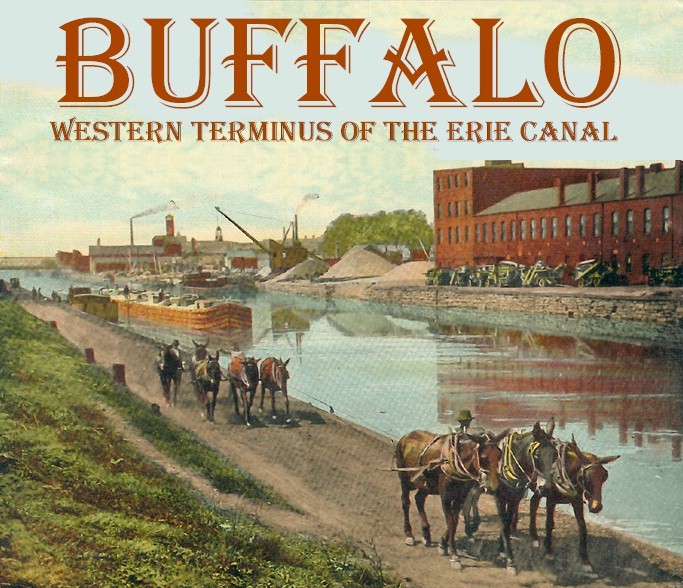
Buffalo, proclaiming “BUFFALO
~ Western Terminus of the Erie Canal”.
·
Management of water-based tours of the Erie
Canal, starting at the Commercial Slip, exiting
to Buffalo Creek and the Inner Harbor, following
the Black Rock Channel and the Niagara River to
Tonawanda, and the present New York State Barge
Canal to Lockport, Henrietta, Albany, etc. and
return.
·
Maintenance of signage and statuary outside the
Canal but in the Commercial Slip, commemorating
events such as the “Wedding of the Waters”
and the Mormon “Miracle at
Buffalo”.
·
An Erie Canal Wall of Honor showing names
of those who built, traveled on, and lived near
the
Erie Canal in Buffalo.
·
A Buffalo Erie Canal Library dedicated to the
history of the Western Terminus, and recording
the names of those associated with it.
·
A compilation of names of builders of, travelers
on and neighbors of the Canal, in computerized
format, developed by a not-for-profit Foundation
from research into public and private records
from Western New York and around the nation.
·
A Buffalo Erie Canal Foundation website which
would permit descendants of those associated
with Canal or Canal District construction,
travel or residency to research their ancestors’
Canal-related activity.
·
A gift shop where items for sale would include:
models and mementoes of the Canal era: packet
boats, longshoremen’s hooks, descriptive books;
and plaques and certificates commemorating
ancestors’ association with the Canal or Canal
District.
In short, the Buffalo Erie Canal Museum
would be the Ellis Island-class
facility envisioned sixteen years ago, by Dr.
Marvin Rapp. The Buffalo and Erie County
Public Library, as well as LDS Church
historians have expressed interest in these
proposals.