
|
|

|
To research your ancestry, start with yourself and
work back. If you're the descendant of
immigrants, you must find their ancestral town.
If you don't know it or are unsure, view the 1950 U.
S. Census on familysearch or Ancestry.com,
below. It will not give their birth town, but it can
have information you can look for in earlier
censuses. Then work back every ten years to the 1940, 1930, 1920 census, and so on (in Canada, generally every ten years on the 'ones'). In the U. S., the 1930 and earlier censuses will give not only the person's age and country of origin, but information on when an immigrant arrived. Use this information to search stevemorse.org below to find the immigrant's passenger manifest, which may show their last residence or their place of birth. Then use the links below for familysearch, Antenati, and/or Ancestry.com, for the ancestral town and birth year to find images of the individual's original records. One of those venues may have all the available records, or you may have to use more than one to get the particular town, year and category you want. Once a person's records have been found, their childrens', siblings', ancestors' and collateral relatives' records can be researched. NOTE: If you have found information about your ancestors on "family trees" on familysearch, Ancestry.com, or other venues, be advised that names and dates in trees ARE NOT "RECORDS". They are what someone else believes to be 'facts'; that is, they are SECONDARY information. The way to build a tree is by finding as many PRIMARY records of birth, marriage, death, etc. as possible, using the links indicated below. Information in others' trees should be considered hints, not proven facts. |
||||
| Sicilian and Italian records are among the best and most accessible in the world. Missionaries of the Church of Latter Day Saints (LDS, 'Mormon') travelled the world in the late 1900s and where they were allowed, they microfilmed documents from thousands of cities, villages and municipalities of all sizes. In the Early 2000s, most of these records were digitized and posted on various on-line venues. | ||||
|
There are two
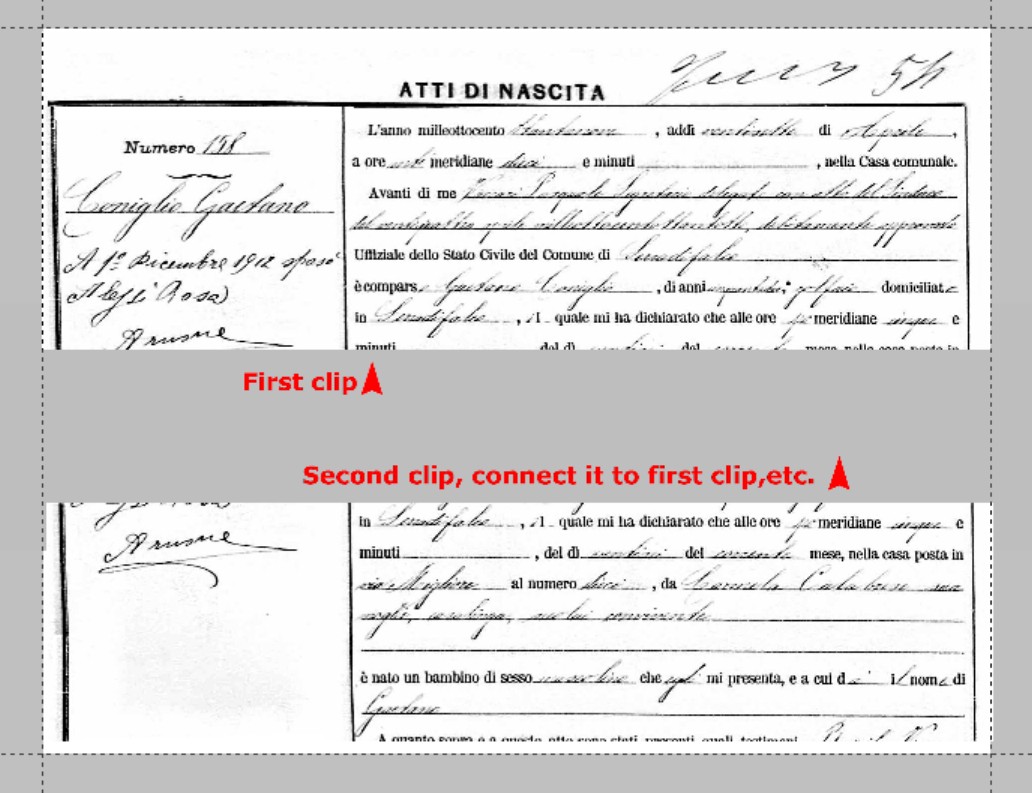
broad types of Sicilian and Italian records: A) Church records: Sacramental records kept by the Roman Catholic Church to document baptisms, marriages, and deaths. Such record keeping began as early as the mid-1500s AD, after the Council of Trent, and continues to this day. B) Civil records: Initiated throughout Europe by Napoleon (the 'Napoleonic Code'), beginning at the start of the 1800s, they recorded births, marriages and deaths, as well as other civil status. Civil records fall into three time periods: 1) The Stato Civile Napoleonico (Napoleonic Civil Status) 1806 - 1815, the period of Napoleon Bonaparte’s dominance in Europe. These records from the North of the Italic Peninsula reflect the diversity of several duchies and city-states. Records for Venezia (Venice) are mostly handwritten and quite detailed, while those for Firenze (Florence) are on pre-printed forms, but with much less information. 2) The Stato Civile della Restaurazione (Restored Civil Status) 1816 – 1860/1865. From 1816, when the Kingdom of Sicily became the Kingdom of the Two Sicilies, through 1819, the southern mainland regions used the same forms as for the earlier years. But in 1820, new pre-printed civil forms were introduced on the Sicilian mainland and insular territories. Northern records were still diverse, often supplanted by church records. 3) The Stato Civile Italiano (Italian Civil Status) 1860/1865 – 1910. Records of the new kingdom of Italy. From 1860 - 1865 these used the previous pre-printed forms. From 1866 - 1874, records completely handwritten, no mention of church sacraments. In 1875 new pre-printed forms were put in use, through 1910 and beyond. Easier to read but generally fewer details than earlier records. Civil records are kept through today, but privacy laws restrict the publication of more recent records. Selected post-1910 records have been filmed and digitized. |
||||
|
Click on the underlined link to reach the venue. |
||||
|
familysearch.org
is the official site of the
Church of Jesus Christ of Latter Day Saints
(LDS, 'Mormon'). This site requires you to register, but
is free to use. No religious requirement, nor
any proselytization by its provider. It has
voluminous genealogical information as well as
access to original vital records from around the
world. The site also permits entry of your family ancestry information to a "world" Family Tree. The above link takes you to the catalog, where an ancestral town name may be entered to bring up a list of available census, church, or civil records. Many records may be viewed anywhere on various devices, some records are restricted but may be viewed for free at an LDS Family History Center (FHC) or at an Affiliate Library. In addition to Sicilian and Italian records, the site has records of all types from around the world, including U. S. and state censuses, ships passenger manifests, etc. For example, index cards held in the Erie County, New York archives for persons who naturalized in Buffalo through 1930 may be viewed by clicking HERE. To locate a Family History Center, or an Affiliate Library, go to Find FHCs |
||||
|
Antenati
is the common name given to the
official Italian Portale Antenati or
Ancestors Portal. It is
free,
and viewable in Italian, English, Spanish, and
Portuguese. It has ONLY Sicilian and Italian
records, mostly civil and some church records. It can be
used to find records that are missing or illegible
on familysearch or other venues. .
|
||||
|
Ancestry.com
is a paid subscription site. Its records include limited
but still useful records from many
villages in several Sicilian provinces. Like
familysearch, it also has records of all
types from around the world, including U. S. and
state censuses, ships passenger manifests, etc.
It can be accessed for free at a Mormon Family History Center, or at an Affiliate Library. Ancestry.com is also a venue that offers testing of DNA through AncestryDNA, and includes the feature of being able to build and maintain your pedigree or family tree on line. Ancestry.com can be searched by a person's name, birth year, etc. that will yield a variety of records, but it also has images of records that must be perused in original form to find what you want. These include passenger records for Ellis Island and its pre-cursor Castle Garden, HERE, and civil records of birth, marriage and death for towns in some Sicilian provinces, including Caltanissetta and Agrigento. |
||||
| Historical Diocesan Archive of Agrigento is a free site which contains church records from the 1500s through the 1940s for municipalities in Agrigento (formerly Girgenti) province in Sicily. | ||||
| ellisisland.org is a free site for searches of ships passenger manifests. Manifests may be viewed but not downloaded, hard copies may be purchased. It can be used to search for records, which may then be found and downloaded from familysearch or Ancestry.com. | ||||
| stevemorse.org is a free site that allows more effective searches of the ellisisland.org site, as well as for ports of entry besides Ellis Island. Searches can be filtered by surname, town name, date of birth, etc. | ||||
|
Sicilian and Italian
cognomi (surnames)
can be searched for on a variety of sites.
One such site is
italia.indettaglio.it This site allows you to enter a surname in any modern Italian region, and see the municipalities and provinces where that name now occurs. This can help narrow down possibilities for an ancestor's ancestral town when it is not known. NOTE: there is advertising before the entry boxes for the name search. Scroll down until you see the start of the table shown below.  |
||||
|
||||
| Along with Ancestry.com are other venues which offer DNA testing and comparison, and their own approach to building on-line trees: 23andMe, MyHeritage, FtDNA and Geni.com. | ||||
| GEDmatch is a free site that allows results from many different DNA venues to be entered and compared. | ||||
| The Buffalo News may be searched by subscribers for articles, death notices and obituaries of Western New York residents. | ||||
| Fulton History is a free newspaper archive of periodicals around New York State that may be searched by name, keyword, etc. | ||||
| Newspapers.com is a subscription site with historical newspaper articles from numerous U. S. states and cities. | ||||
| On line searches by name can be run on free sites like Wikipedia, YAHOO!, and facebook. | ||||
| Google Translate, a free site, will translate words or phrases to or from one language to another. | ||||
| Individual words can be translated from English to Sicilian or Sicilian to English, at English-Sicilian | ||||
| When an address is known, some U. S. Censuses may be searched by Enumeration District or 'ED', for residents' information. | ||||
| For links to numerous Sicilian genealogical topics, go to Sicilian Links. |
|
|||
| See our page about the proposed CCI Story Booth, where you will be able to have your immigrant ancestors' history archived: www.bit.ly/storyboothcci |
