6)
UNDERSTANDING THE RECORDS
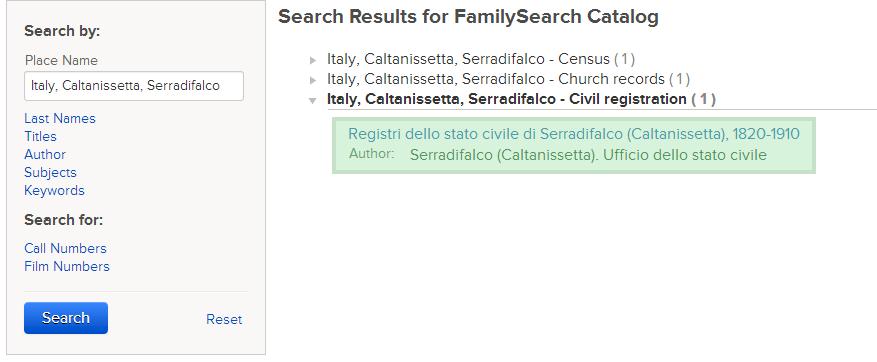
The site
www.familysearch.org has
instructional videos on genealogy research for many nations. An
excellent one explaining and giving examples of Italian records is at
https://www.familysearch.org/learningcenter/lesson/basic-italian-research/246
The
video can be watched on-line. It may take a little
time to download, but it is well worth the wait.
Types of records:
There are several types of records. Within each type, the information contained can
range from clear, detailed and complete, to poor
and spotty. The book
cited above, (i) "A Genealogist's Guide to Discovering Your Italian
Ancestors" gives
examples of Civil Records in Italian, with translations to English.
CENSUS RECORDS were recorded in Italian, and may give information on land
ownership, other property, etc. Generally they don't give genealogic information,
but may help to confirm the identity of an individual found in other records.
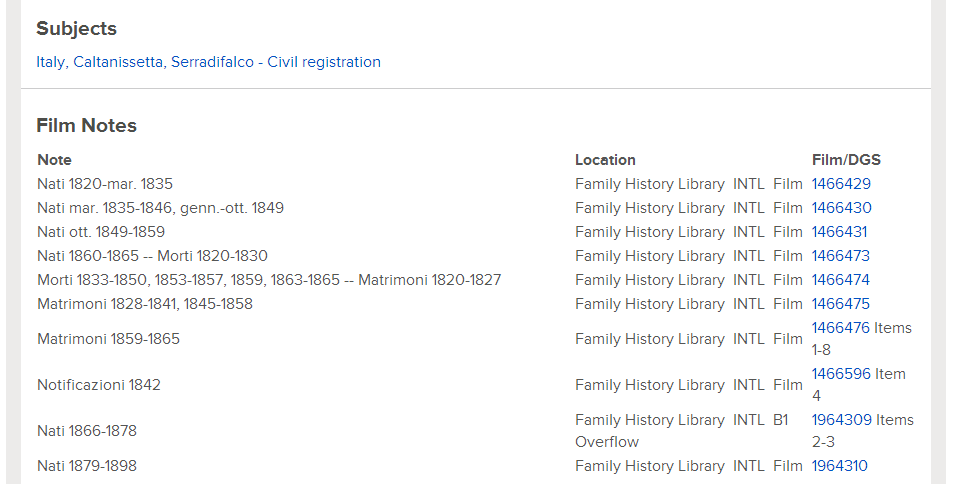
CIVIL RECORDS (Registri Stato Civile) were recorded in Italian, and can include Birth Records (Atti di Nascita) , Marriage Banns (Pubblicazioni
or Notificazioni),
Marriage Records (Atti
di Matrimoni),
Attachments to Marriage Records (Allegati), or Death Records (Atti di Morte).
Records from 1820 through about 1864 were on pre-printed forms which were
filled in by hand, with the names, dates, and other pertinent information
written in the appropriate space. These early forms also sometimes
acknowledged that a church sacrament had been given, but from about 1865
through 1875, church and state were at odds: the combined records ceased and
the Civil records were completely handwritten and showed only secular
information. From 1876 through 1920, the records were again
preprinted, showing only birth information.
All these records follow more or less
the same format that was established by
Napoleon, even though he never ruled in southern Italy or Sicily, and are
called Napoleonic Records.
CHURCH RECORDS (Registri
Ecclesiastici) were recorded
(generally handwritten) in
Italian or Latin. These include Baptism (Battesimi) Marriage (Matrimoni)
Confirmation (Cresime) and Death (Morti) records.
Later records may be handwritten in Latin on forms pre-printed
in Latin.
INDICES can be invaluable time-savers when looking for an individual whose birth
date (or other important date) is uncertain. .In many cases, each of the
above types of records have a separate Index of the names in the actual record.
The names can be quickly found in the Index, which will indicate the page or
record number to see, for the full record.
It should be noted
that these records were not in the familiar form of the Birth Certificates
or Marriage Certificates that are issued today in America. The records
were original documentation of events (called 'primary records'), kept in a ledger in the town hall or
the church rectory appropriate to the event.
The
participants were not given a "certificate". If a person needed proof
of his birth (or his marriage, etc.) for some later activity, he was issued an
extract (estratto) of the record. These extracts gave only the
important details: for example, for a birth, they give the birth date and
the name of the child and its parents' names, without giving
occupations, ages, or an address, as are often given in the original record.
Many American children of immigrants have what they believe are "Birth
Certificates" or "Marriage Certificates" for their parents, but are
actually extracts. Therefore, much more information may be available
in the original records.
6B) CIVIL RECORDS
.
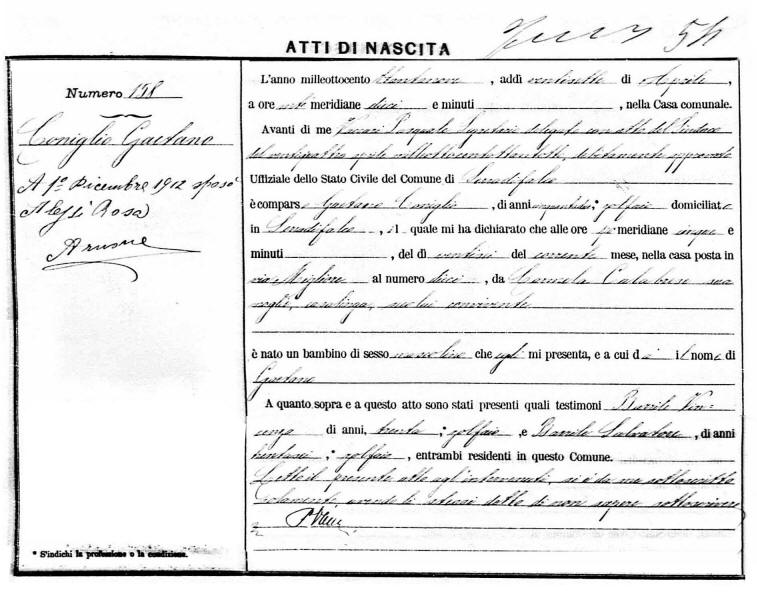
Civil Birth Records (Atti di Nascita), in their most complete form, give the following
information:
To the right or left
of the record, below a sequential record number, the newborn's name
is written, usually surname first, then the given name. At the
top of the record is the date on which the newborn was presented to
the town's Official of Civil Records or registrar, followed by: the
official's name and title; the name of the person presenting the
child (the 'declarant', usually the child's father); the declarant's
age and occupation; the gender of the child and the date and street
address of birth; the name of the child's mother and a statement
that she was the wife of the declarant, living with him; and the
given name of the child (the surname was not given, as it was the
same as the father's. Then were listed the names, ages and
occupations of two residents of the town who witnessed the
presentation of the child and the father's declarations.
Many records give more
information, such as the name of the fathers of the declarant and
his wife, and of the witnesses, and whether they were living at the
time of the recorded birth; or the age and occupation of the
newborn's mother. Actually, older records are more likely to
give these details.
If the declarant was not the father, the names
of both the declarant (sometimes an aunt or a midwife) and the father are given.
Finally
there was a statement saying that the above record was
read to all those assembled. The record is undersigned by the
registrar (the town mayor, councilman or other
official), and by those present who know how to write.
Commonly, there was a
statement included at the end of the record saying it was signed only by the registrar,
the others not knowing how to sign.
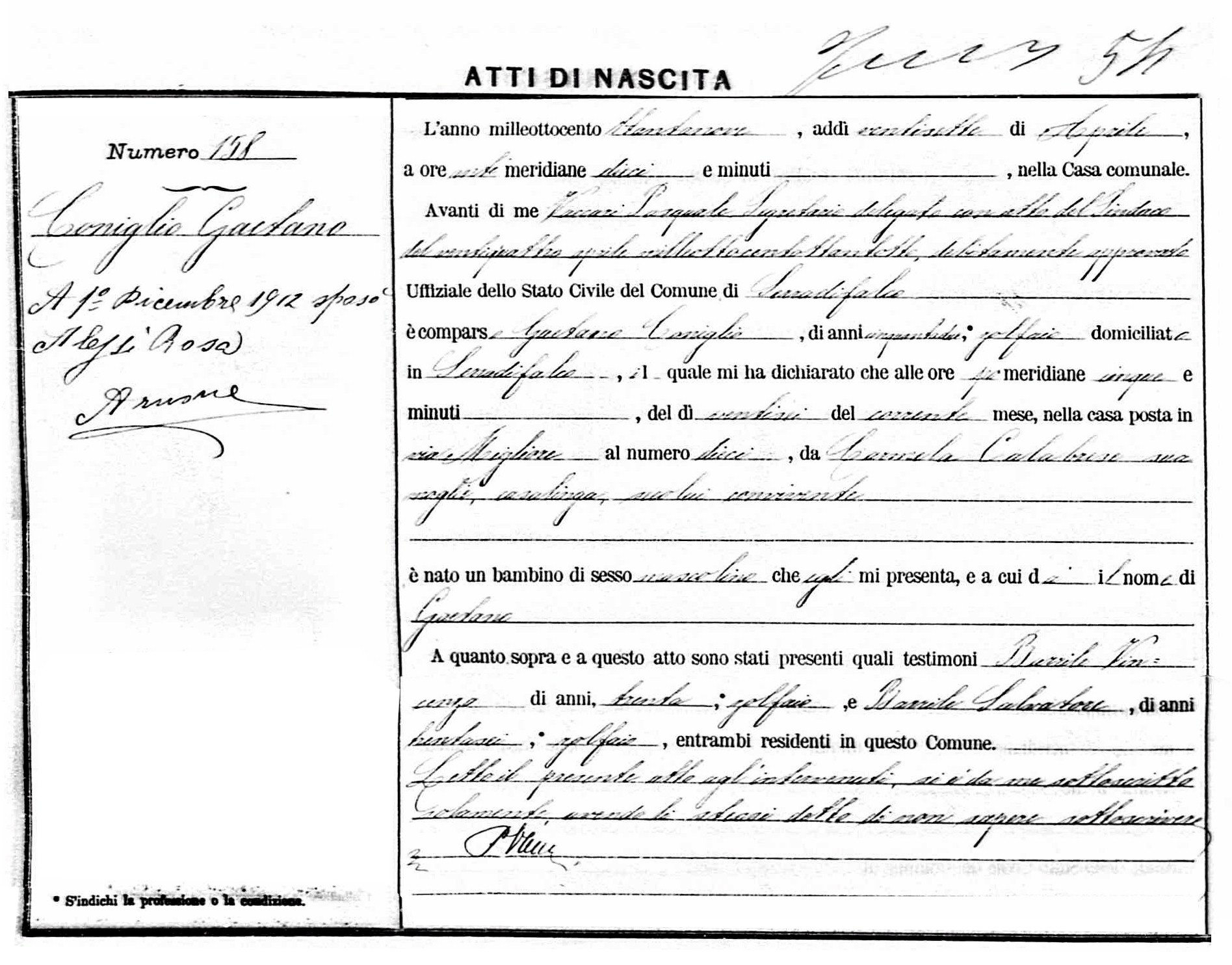
A complete birth record can be
invaluable, because it not only gives information about the child, but from the ages of
the parents and grandparents, their birth years can be estimated. Below is an
example of a typical birth record, in its original form
(click it to enlarge
it), then transcribed in Italian and then translated into English. The
birth information is on the right. On the left is the record number, the child's
name, and (sometimes) Margin Notes, which were
added to the record at some time later than the birth. There will be more about Margin Notes later. On the
transcription and translation, information in black
is "boilerplate", while blue
shows the hand-written entries. Note
that in the example, the record date is April
27, but the actual birth date was given as
April 26.
. |
|
 |
| |
|
|
Numero 158
Coniglio Gaetano
A 1o Dicembre 1912 sposó
Alessi Rosa
Arnone
.S'indiche
la professione o la condizione. |
|
L’anno
milleottocento ottantanove,
addi ventisette di
Aprile,
a ore anti meridiane
diece e minuti ___, nella Casa
comunale.
Avanti di me
Vaccari Pasquale
Segretario delegato con atto del
Sindaco del ventiquattro
aprile milleottocentoottandotto, debitamante approvato, Uffiziale dello Stato Civile del Comune di Serradifalco ______________
è comparso
Gaetano Coniglio,
di anni cinquantatre,h
solfaio
domiciliatio
in
Serradifalco, il quale mi ha dichiarato che alle ore po
meridiane cinque
e minuti __________, del di
ventisei del
corrente mese, nella casa posta in
via Migliore al
numero diece,
da Carmela
Calabrese
sua
moglie, casalinga, seco lui convivente
___________________________
_________________________________________________________
e nato un bambino di sesso
mascolino che igli mi presenta e a cui da il nome di
Gaetano
______________________________________________
A quanto sopra e a questo atto sono presenti quali testimoni Barile Vin
cenzo____ di anni,
trenta,h
solfaio, e
Barile Salvatore,
di anni
trentasei,h solfaio,
entrambi reidente in questo Comune. ______________
Letto il presente atto agli
intervenuti si e da me sottoscritte
solamente, avendo li stessi detto
di non sapere sottoscrivere
P Vaccari_____________________
_________________________________________________________
|
|
| |
|
|
Number
158
Gaetano
Coniglio
On 1st
December 1912
married
Rosa Alessi
Arnone
hIndicates
occupation or status.
|
|
In the year
one thousand eight
hundred
eighty-nine, on day
twenty-seven
of
April, at
ten o'clock
AM,
in the Town Hall.
Before me,
Pasquale Vaccari,
Secretary
delegated by act of the
Mayor on twenty-four April
one thousand eight
hundred
eighty-eight, duly approved,
Official of Public Records of the Town of
Serradifalco ___________ appeared
Gaetano Coniglio, age
fifty-three,ha sulfur miner
living
in
Serradifalco, who has declared to me that at
five
o'clock
PM,
minutes ____ on day
twenty-six of the
current month, in the house located at
via Migliore
number
ten,
by
Carmela Calabrese,
his wife, a homemaker, according to him living with him,
______________________________
_________________________________________________________
is born a baby
boy who was
presented for me to see, and who was given the name
Gaetano
______________________________________________
To the above, and to this record, are present the
witnesses
Barile Vin
cenzo
age
thirty,ha sulfur miner, and
Salvatore
Barile, age
thirty-six,ha sulfur
miner, both residents of this
community.
____________
The present act
was read to those in attendance but is signed by me
alone, the
informant and witnesses having said that they don't know how to
sign
P Vaccari_____________________
_________________________________________________________ |
|
| |
|
Civil
Marriage Records (Atti di Matrimoni) can be confusing. Often there are records of the "solemn
promise to marry", and/or actual records of the wedding. Also, many
couples were first married at the local church, and later (sometimes days later) they were married in the town hall in a civil ceremony, which
legitimized their future children. For this reason, civil marriage records
often had a different date for a marriage than the church marriage records (see below).
Civil marriage records
give the date of the event (in the civil setting), and the spouses'
names, age, and occupation, as well as their "condition": celibe
(previously unmarried male), nubile (previously unmarried
female), vedovo (widower) or vedova (widow). If
the person was previously married, the name of the deceased spouse
is given. Also given are the names of the newlyweds' parents
and whether they were living or deceased at the time of their
children's marriage. Occasionally the ages and occupations of the
parents might be given, and in some cases even the names of the
parents' fathers. The records also often give the names of witnesses
to the marriage. These witness could be relatives, providing
further information about the family. Sometimes an enumeration
of supporting documents is given: birth records, death records of
previous spouses, etc.
Copies or extracts of
these supporting ancillary records, called Allegati,
(Attachments) may be available. They vary in their
completeness and usefulness from town to town. In their best
form, they may have handwritten copies of original birth or death
records, or at least extracts.
. |
|
Civil Death Records (Atti
di Morte), at
best, give
the name, age and occupation of the deceased; the name of the
deceased's spouse or father; the place of death (but I've
rarely seen a cause of death given!); the name(s), age and address of
those reporting the death; of witness(es) to
the death record and of the clerk or registrar.
If the decedent was married, the name of the spouse is given, and if the decedent was a widow or
widower, the name of the deceased spouse is given. |
|
6C) CHURCH RECORDS
Church
records generally are less detailed than civil records. Often only
the ages of the principles (baptized, confrmed, married or deceased) are
given; those of their relatives or sponsors are not.
.
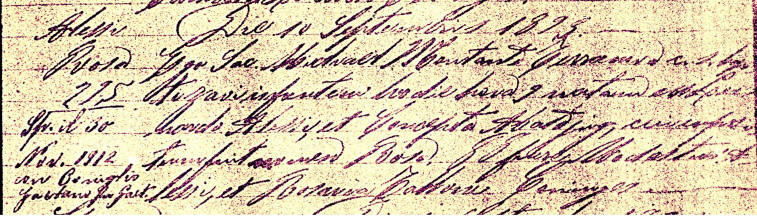
Church Baptismal Records (Battesime) were often in Latin. They are generally handwritten, but follow a
relatively standard form that gives: the year, date, and hour of the record; the priest's
name and title; the time and day of the baptism; the father and his father's name; the
mother and her father's name; the child's sex and name; and the names of the child's
godparents and their relationship to each other.
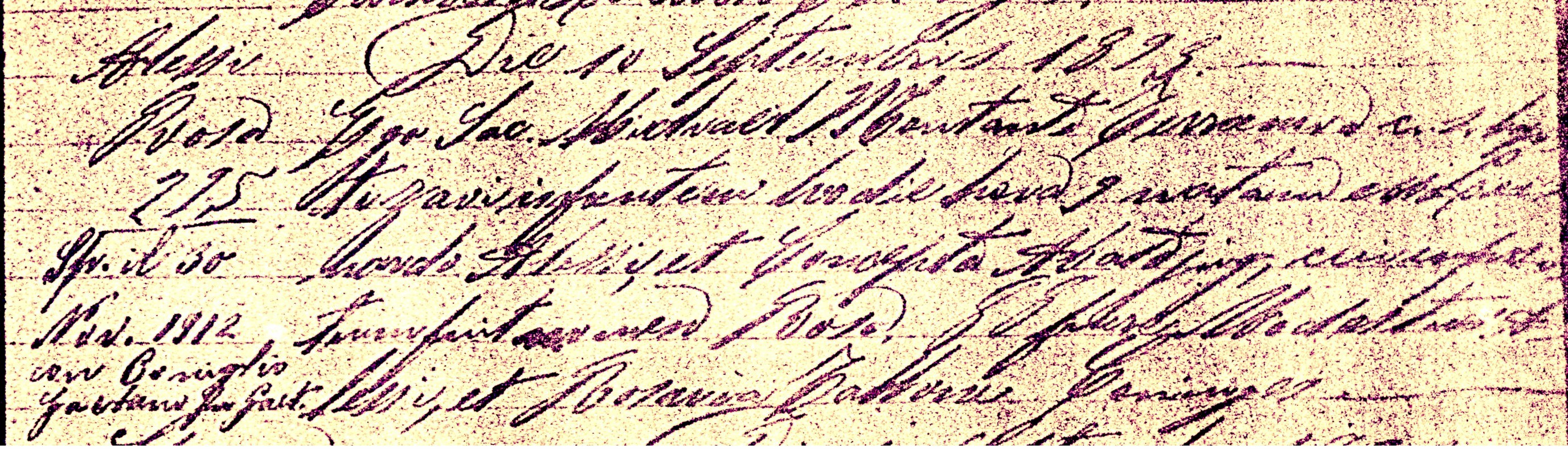
Below is an example of a typical baptismal
record, a trancription and a translation. The names are Latin versions and may not
be spelled exactly as the actual Italian name. Rather than giving an
actual date of the baptism, often the record says "hodie" (today) or "heri" (yesterday), and the baptism date must be calculated
from the record date. Again, the record contains Margin Notes. Notice that the church record's margin note
gives November 30, 1912 for the marriage date
of Gaetano and Rosa, while the civil record's margin note gives their marriage date as December 1, 1912. This
record gives no birth date, however, some baptism records state
"today I baptized an infant born yesterday", etc., from which the
birth date may be deduced.
. |
|
 |
| |
|
Alessi
Rosa
295
Sp. il 30
Nov. 1912
con Coniglio
Gaetano fu Gaet. |
Die 10 Settembre 1893 Ego Sac. Michael Montante Terranova, c.s. bap
tizavi infantam hodie hora 9 natam ab Leo
nardo Alessi
et Concepta Abate jug, cui imposi
tum fuit nomen
Rosa. PP fuere Modestus A
lessi et Rosaria Tabbone Conjuges. |
| |
|
Rosa
Alessi
295
Married
30 November 1912
to Gaetano Coniglio
son of the late Gaetano Coniglio |
September 10,1893 I, Priest Michele
Montante Terranova, High Chaplain, today at 9 :00 hours baptized an infant, daughter of
Leonardo Alessi and Concetta Abate, and to whom the name given was
Rosa. Godparents were Modesto Alessi and
Rosaria Tabbone, husband and wife. |
| |
Church Marriage
Records (Matrimoni)
Church marriage records
give the date of the ceremony, the names and sometimes the ages of
the spouses, their parents' names and
whether the parents
were living or deceased at the time of their children's marriage.
Ancillary records may include pubblicazione (banns) which the
church posted in advance of the marriage to assure that the
betrothed were not otherwise encumbered. Care must be taken
to recognize that the dates of the banns are not
wedding dates, but banns usually give the same information as
actual marriage records. Church records from some towns have the added
information of a family tree, to show the proper degree of
separation between prospective spouses. Second cousins were
allowed to marry, but first cousins required special dispensation.
These charts were rudimentary, and did not give birth dates for the
ancestors, but did show names and relationships. In any event,
an ancestral tree, even a simple one, certainly extends one's
knowledge of the family.
|
Church Confirmation Records (Cresime)
Confirmation records
usually
give the name of the confirmed party, his/her parents, the name of the
sponsor of the confirmation, and the priest involved. Often
no ages are given, and
the only date is the date of the ceremony. But confirmations were usually performed
when the child was an early teen-ager, so an approximate birth date can be
determined, as
well as secondary proof of the parents' names.
. |
Church Death Records (Morti)
Church death records also give limited
information, but can be helpful. At their most complete, they give the name
and age of the deceased; the names and status (whether living
or dead) of the parents of the
deceased; and the name of the spouse, if any. Cause of death is
given
only in rare cases.
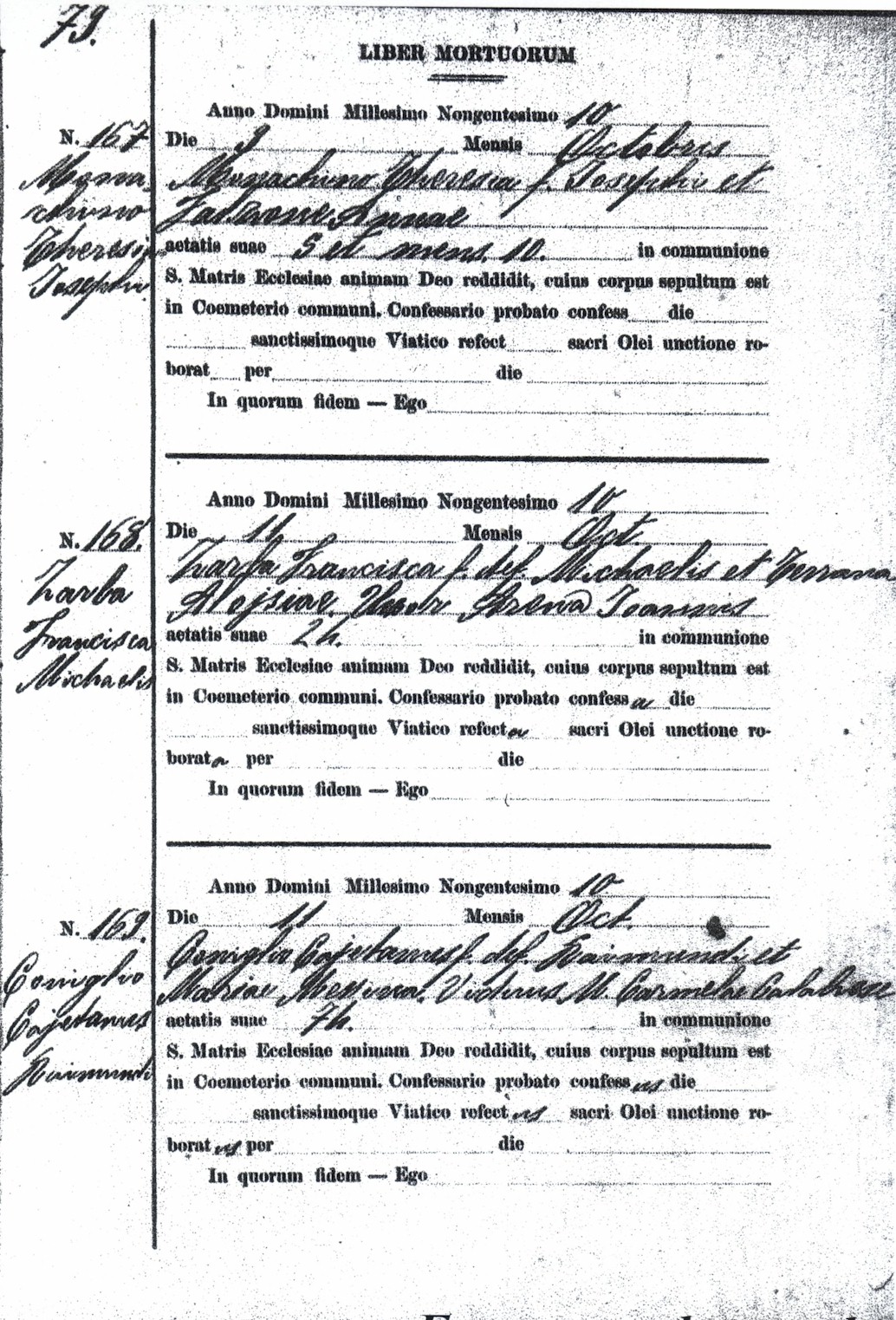
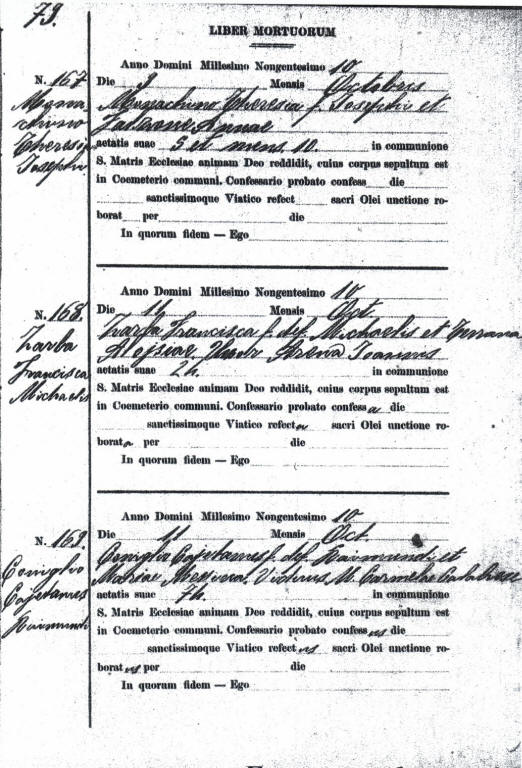
Below is the church record of death of my
grandfather, Gaetano Coniglio. The entire page from the ledger
is shown. The title of the page is LIBER MORTUORUM 'Book of
the Dead'. At the upper left is the page number, 79. In
the left margin are record numbers for each decedent, along with
the name of the deceased and the first name of his/her father.
Only the first name of the father is given in the margin, since
since both men and women kept their birth surname throughout their
lives, so including the
father's last name in the margin would have been redundant.
My grandfather's death record is the last
on the page, N. 169. Click
the document to enlarge it.
|
|
 |
|
LIBER MORTUORUM
======== |
|
N.
169.
Coniglio
Cajetanus
Raimondi |
|
Anno Domini Millesimo Nongentesimo
10
Die
11
Mensis
Oct.
Coniglio Cajetanus f. def.
Raimondi et
Mariae
Messina. Viduus
M. Carmelae
Calabrese
aetatis suae
74.
In communione
S. Matris Ecclesiae
animam Deo reddidit,
cuius corpus
sepultum est
in Coemetario communi. Confessario probato confessus
die
santissimoque
Viatico refectus
sacri Olei unctione ro-
boratus
per
die
In quorum fidem --- Ego
|
|
The abbreviations above are: |
f. ~ filius
(son)
def. ~ defuncti
(the late)
M. ~ Maria
S. ~
Sanctis
(Holy) |
|
.
|
|
BOOK OF DEATHS
======== |
|
N.
169.
Gaetano
Coniglio
of
Raimondo |
|
Year of Our Lord One Thousand Nine Hundred
10
Day
11
Month
October
Gaetano Coniglio son of the late
Raimondo and
Maria Messina. Widower of Maria
Carmela
Calabrese
his age
74.
whose soul returned
to God
in communion with Holy Mother Church
, and whose
body is entombed
in the communal Cemetery.
He
was confessed
by a qualified confessor on day
and
was
sent on his sacred
Journey refreshed and
strengthened by holy
anointing Oils
by
on day
According to which faith --- I
|
|
|
Although the last lines were left blank, it can be assumed that the
sacrament of Extreme Unction was given, since the words refectus
and roboratus
were completed by hand. The priest did not bother to sign his
own name. My great-grandfather's name was Raimondo. The
form Raimondi is Latin for 'of Raimondo'.
Similarly, Mariae and Carmelae are the possesive forms
of Maria and Carmela.
The record not only gives the date of
death, but names my grandfather's parents and wife, and indicates
that they had died before he did. Searches for their
death records can therefore be limited to dates before October 11,
1910. |
|
|
6D) INDICES
.
Civil or
church records of every form may have Indices. These are tabulations of the acts that were
recorded over some period of time, generally a calendar year. There is much
variation in the indices, depending on the type of basic record, the historical period,
the dedication and neatness of the clerk, etc.
Indices are generally at the beginning
or end of the year's records, but may be reproduced in the middle of a year. A
typical index in a birth record will have all the names of children born in a given year
arranged alphabetically by last name, with an associated record number and/or page number.
Find the person's name, read the associated page and record number (in Italian, "Pagina"
and "Numero d'ordine"), and go to that page and number to read the
actual record.
Sometimes the index will have only
the name of the infant; sometimes it has both parents' names and the child's birth date.
Sometimes, unfortunately, it will be alphabetized by first name, not helpful
if you don't know it and must look at every name in the index! You may have to do
that also if the index is not alphabetized, but just a sequential chronological list of
the entries in the actual record.
Indices often use shorthand
espressions. Giuseppe may be shortened to "Gpe", Vincenzo to
"Vo", Maria to "Ma", etc. If the surname ("cognomen"
in Italian) is a compound name like Lo Guasto, Di Giugno, or D'Amico, it may be listed in
the index as Guasto, Giugno, or Amico. Or, the full name may be spelled out, but
Di Giugno and Lo Guasto may be listed with names starting with "G" and D'Amico
with names starting with "A". |
|
6E) MARGIN NOTES
.
Civil or
church records of every form may have Margin
Notes. These are generally notes that a
clerk has added to a record, some time after the record was originally written.
These may include information about marriage, death, or other events involving the
individual for whom the record was originally made. |
| 6F) OTHER POINTS 6F i) Parents' status: Some information can be extracted
from simple sources if key words are noted.
For example, if a record says the mother of a
child is
"Angela Digiugno di
Leonardo" that means she is the
daughter of Leonardo Digiugno, who was living at the time the birth was recorded. If it says "Maria Digiugno fu Leonardo" it signifies she is the daughter of Leonardo Digiugno, who
was deceased at the time of the record.
6F ii) Relationships: If the declarant at a
birth registration is not the father, the record may say something like "Rosa Digiugno, zia del neonato", that is,
"Rosa Digiugno, aunt of the newborn".
This tells you that "Rosa" is the father or mother's sister, and
you can add another name to the family tree.
Since godparents are often relatives of the
baptized child, information about godparents in baptismal records can help trace lineage
and relationships beyond those of the child. The same is true of witnesses to birth
or death records.
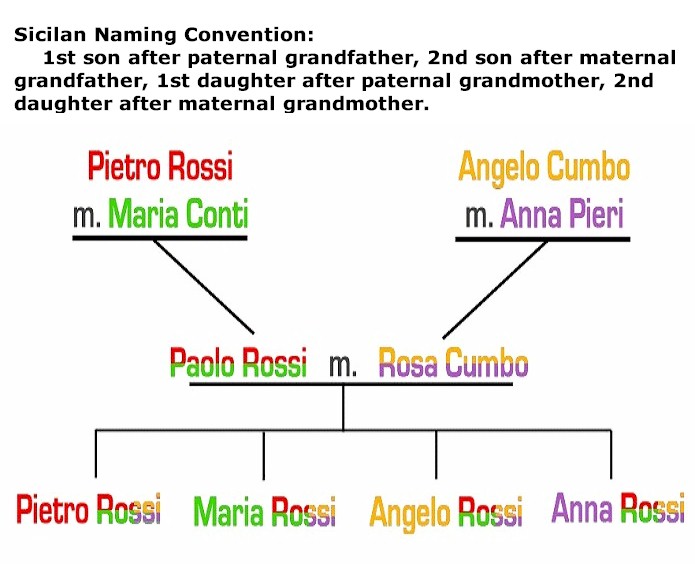
6F iii) Naming conventions: Knowing the country of origin's
conventions or rules for naming children can help find or associate people. In Italy
and much of Europe, a couple's first male child was named after the father's father.
The first girl was named after the father's mother; the second son was named after
the mother's father; the second daughter was named after the mother's mother.
Later children were often named after more
distant ancestors, or after aunts and uncles. Sons were infrequently named for their
own father, and when they were, it was usually after the "conventional" names
were "used up", or when the husband died before his wife gave birth. Then
the child was often named for his late father.
A similar and intriguing custom appears to
have been for widowers to name their first daughter with their second wife after their
deceased first wife!
Knowing these customs can help you to confirm
that a certain individual is indeed the grandson of another, since his first name is the
same, etc. The naming convention sometimes produced maddening numbers of cousins
with exactly the same first and last names. But it also kept names "in
the family", so that you can become familiarized with a set of names that are common
within your family, and recognize the names of relatives more easily.
|
7) OTHER RESEARCHERS
Thousands of amateur and professional genealogists and researchers have websites. A
new researcher should use the resources of the World Wide Web as much as possible.
Learn how to do "Yahoo!"
or "Google"
searches. Search for a name, a town or a genealogical phrase and often dozens
(sometimes hundreds) of potentially helpful sites come up. Some of these are what I
call "index" or "summary" sites: they may not have information
themselves, but can point you to other sites that do.
Many of the sites you find will be
commercial, that is, they will sell you information for a price. The Mormon
Family History Centers commonly have computer rooms where users can access the most
popular of these sites for free, allowing you to search for and obtain information on the
census, death records, newspaper obituaries, etc. Try them at the FHC, and
then decide if the price the sites ask is worth it, before you register and pay for
access.
A good example of an "index
site" for Italy is
"Mimi's", which lists Italian and Sicilian towns, and sites that
have information on the vital records of those towns.
Many researchers have uploaded their
family trees to various paid and free sites. Often, a "Yahoo!"
or "Google"
search
of an ancestor's name will return a "hit" to one of these sites, where the
creator of the tree may be contacted to see if they are willing to exchange
information with you. One of these is
(vi)
http://www.rootsweb.ancestry.com/
This
site is associated with Ancestry.com, but is free to access and to register.
For free searches, enter the surname or the full name you're researching in
the blocks under "Search Rootsweb.com". A list of people with that
name will appear, and you can browse the entire family tree in which a name
appears, and contact the creator of the tree. If you have a database
from your own genealogy program, you can upload it for free, for possible
relatives to see, and contact you in turn.
MORE TO COME
(Last
revision:
11 May 2019 ~ if you have questions,
contact: Angelo F. Coniglio,
GenealogyTips@aol.com) |