This is a
history of Sicily. In 1912 and
1914,
Gaetano and Rosa Alessi Coniglio emigrated to America
from Serradifalco, Caltanisetta, Sicilia
(Sicily, Italy). Other locations on this site address
their home village of Serradifalco
(Sicilian Serradifarcu),
but this page is devoted to their country of
origin, Sicily. The latter statement may be taken as
ambiguous. Wasn't
Italy their country of origin?
Isn't Sicily in
Italy? Well, yes and no.
Sicilia
(See-CHEE-lee-uh) today is an 'autonomous region' of the Italian
Republic.
When Gaetano and Rosa lived there, it had been officially a
part of the Kingdom of Italy only since that country's creation
in 1861, less than thirty years before Gaetano was born. Gaetano's
parents were born well before that date. His four grandparents were born before 1812, while
the feudal system that began in the Middle Ages was still being
practiced in Il Regno
dei Due Sicilie
(the Kingdom of the Two Sicilies) and the land was still under the destructive and demeaning yoke of
Spain.
Before that, Sicilia's
political status ranged from that of a lowly penal colony to the
heights of an independent kingdom, with a variety of conditions
in between. Its rich history makes it one of the most
culturally sophisticated and diverse places in the world, while
at the same time some regions of the island bear a long
tradition of misery and hardship. Because it is an island,
because of its proximity to the African continent, and because
of its history of domination by other cultures, Sicilia
is unique, and different from 'Italy'. As a child of
Sicilians, I feel a strong
bond to
Sicily.
To me, though Sicily is now part of Italy, "Sicily is not
Italy, and Italy is not Sicily."
|
Sicily
was a distinct nation seven hundred and
thirty-one years before the present nation of Italy
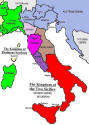
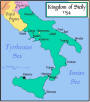
existed. This map from
1860, just prior to the 'unification of Italy', shows
that there was no nation called Italy, and that the largest
nation in the region was the Kingdom of the Two
Sicilies, a direct successor of the original
Kingdom of Sicily (Il Regno di
Sicilia)
established by the Normans in 1130. That
nation, the first 'modern' state with a tri-partite
government, was so renowned that it was referred to
throughout Europe simply as Il Regno:
The Kingdom. No other description was
necessary. |
|
 |
|
|
|
An early name given to
Sicily
by the Greeks was
Sicania, reinforcing
the hypothesis that a people called Sicans or
Sicani were indigenous. The name
Sicilia was also derived from the name of another of
the early tribes to live there, the Siculi.
Because of its obvious shape, the ancient Greeks gave it the name Trinakrias
(Triangle). The ancient Romans changed that to
Trinacrium, and the later Italians called it
Trinacria as well as by its ancient and present name, Sicilia.
It's likely that most
Sicilian-Americans today rarely think of themselves that way.
American culture counts the descendants of Sicilians, Romans,
Neapolitans and Venetians alike, as 'Italian-Americans', and
only when they are pressed (and if they remember) do the
Sicilian-Americans concede a difference. It should
be noted, however, that American descendants of mainland
Italians are
often careful to note a distinction between themselves and those
of Sicilian descent.
This page is to give
Gaetano and Rosa's descendants (and anyone else who is
interested) some sense of what it means to be
Sicilianu. Some of this is from my experience as a
Sicilian-American, and from reading texts and on-line
reports of Sicilian history, politics, and culture. Some
of it is factual, some is my opinion, based on several different
views of the same information. Rather than giving
references, generally I link a word or phrase from the
discussion to a page or site that addresses the topic at hand.
Because of my heritage, associations with the 'comune'
(town) of Serradifalco and
its 'Provincia' (Province) of Caltanissetta are inserted at various appropriate points.
I start with a general description of the island/country, and
then give historical highlights I find intriguing, and which
shed light on the development of the character of modern
Sicilians and the descendants of Sicilians. A link to a
page listing interesting Siculo-centric sites is presented at the
end of the history. |
|
|
|
Sicilia is a
mountainous triangular island in the southern Mediterranean Sea,
just about ten miles off the 'toe' of the 'boot' of the Apennine
Penisula
and only about 100 miles from Tunisia, Africa. It's about 150
miles across at its widest, and has a surface area of about 10,000
square miles, about the same size as North America's Lake Erie.
Most of the island's surface is
mountainous and hilly, with some level coastal areas and a large
plain, in the east, near Catania.
Though heavily deforested over the ages,
Sicilia continues as a source of
citrus, olives, and wine grapes. Through the centuries, its sulfur, now
greatly depleted, once provided major income to the island, and
during the invention and prominence of gunpowder weapons, was a
driving force behind various intrigues to control the Island.
For millennia, the bluefin tuna
(tonno) has returned from the Atlantic Ocean, to enter the Mediterranean
Sea to spawn. Since pre-Moorish times, Sicilian fishermen have
organized tuna hunts, called by the Spanish name mattanza,
to trap thousands of tuna (during peak years) in tonnara,
a complicated system of nets which lead the fish into the
Camera delle Morte, the Chamber of Death, in which a movable
bottom is raised to allow fishermen in small boats to gaff and
capture the giant fish. The methods, now modernized, still
incorporate elements that are thousands of years old, and the event
is as much ritualistic as physical, with fishermen chanting songs so
old that even they don't know the meanings of many of the words.
The leader of a team of tuna fishermen, is called a rais,
an Arabic word meaning 'chief'. Because of overfishing and pressure by competing modern foreign
fishing vessels, few mattanza still occur. A
famous one survives, a shell of its former self, with a
tonnara at
Sicilia's western offshore island of
Favignana. During the late 19th and early twentieth
century, it was an important element of Sicilian economy, with its
canned tuna shipped worldwide. Teresa Maggio's
book Mattanza: Love and Death in
the Sea of Sicily is an absorbing description of the
spectacle.
Sicilia's population at the start of the twenty-first century was five
million. |
|
|
ORIGINAL INHABITANTS
(10,000 ~ 1,200 BC) |
Sicilia
was a point of convergence between North and South, East and West,
between Europe and Africa, and eventually between the Latin world
and the Byzantine. But before incursions from all points
of the compass,
Sicilia had been inhabited since
prehistoric times, as attested by human (or pre-human) fossils
believed to be a half-million years old. Cave drawings exist
from about 12,000 years ago, but it's not known whether the people
responsible (the
first inhabitants of the Italic region), were originally from the north (Europe) or south
(Africa).
The first identifiable culture
of Sicilia existed about 8,000 years ago
(6,000 BC, about the time of the first records of civilization in
Egypt): the
Sicani (See-KAH-nee), Sicans or Sicanians, reputedly from the area of
present-day Libya in Africa, developed a culture on the southwest
coast and the central interior of the island, and likely overspread
the entire island at one time.
The name Sicani is
derived from the Greek word
'sika' (Italian 'selce'), meaning chalcedony, a
quartz-based type of rock that includes
agate and
tiger's eye, and which was plentiful in the areas inhabited
by the Sicani. Indeed, probably the earliest external name for
the island was the Greek
Sicania. Kokalos was a legendary king of the Sicani.
An alternate version of the origins of the Sicani is given by the
greek historian
Thucydides in about 420 BC, claiming that they were from an
area near the River Sicanus in the Iberian peninsula (today's
Spain).
Some sources say the Sicani were the
dominant culture for about 4,500 years until being joined by the
Siculi (SEE-kooh-lee), or the Sikels, Sicels or Siculiani, in
about 1,400 BC (the time of Moses). The Siculi originated in
the North, on
the Apennine Peninsula, and settled in the eastern part of the
island, closest to the toe of the peninsula's 'boot'. They
worshiped their own god,
Adranus, said to live under Mount Etna. Adranus, for
whom the town of Adrano is named, grew to be worshipped
throughout the island, by native Sicani and Siculi alike. The island's
name seems to have been a combination of the names of these
two peoples:
Sicilia, 'Land of the Siculi and Sicani'.
In about 1,200 BCE (about the time of the Trojan War), the
Elami, or Elymians, possibly of Trojan (modern Turkey) origins,
settled in northwestern
Sicilia.
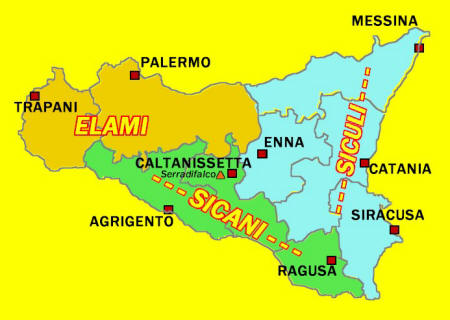
The map below shows the location of these early cultures with
respect to the nine present-day provinces of
Sicilia, each with its capital city of the same name.
It is not evident whether the Elami, Sicani and
Siculi were physiologically different peoples, or whether they
were essentially the same stock, with cultures differing due to
varied external influences in the east and west of the island.
Serradifalco and its provincial capital
Caltanissetta are essentially at the geographic center of
the island, the lands of the ancient Sicani. The map
shows, however that those towns are also close to the borders of the
Elami and Siculi. Prehistoric tombs can be found in Serradifalco's
Grutta d'acqua (Cave of water) district. While today's Sicilians, in
general,
are certainly a
mix of the many races, peoples and cultures that have infused the
island over the millennia, it is not difficult to imagine that some
residents of the interior could be direct descendants of the
ancient Sicani,
Elami and Siculi. |
|
 |
These three cultures, the
Sicani,
Elami and Siculi, were
the oldest known in
Sicilia and can be considered the
'indigenous peoples' who thereafter were beset by invaders,
captors, and
conquerors from virtually every part of the known
world. Before this onslaught, several native centers of
population existed, including the Sikel town of Cale Acte (now
Caronia) on the northern coast; the Elymian inland towns of Segesta
and Entella (Contessa Entellina); the Sikel's eastern towns of Agyrium (Agira), Aetna (Adrano), and Tauromenium (Taormina); and the
central city of Enna, originally a Sicanian stronghold. The
earliest names of these towns are lost in the mists of time, except
for that of
Enna,
established in about 1200 BC. This was the name of the ancient
town, much later changed to Castrogiovanni (John's Fort), and
still more recently returned to its earlier name, Enna, which
evidently derives from
'Henna', its Sicanian
appelation. As such, it
bears the distinction of being
Sicilia's oldest and highest major city, and
seat of the only Sicilian province without a coastline. Like
Caltanisetta, only twenty-two miles distant, it is near the
geographic heart of
Sicilia. On the boundary of the
areas first populated by the Sicani and the Siculi, control of Enna
was once contested by both those peoples. The area of the
present Serradifarcu may also have been a boundary of these tribes,
as ancient tombs found in its Grutta d'acqua district have
variously been attributed to either culture.
Unfortunately,
other than Elami writings using Phoenician symbols but in the (to
date) un-deciphered Elamian language, all written history of the
three aboriginal Sicilian groups is to be found only in the texts of
other cultures, mainly those of the Greeks. |
|
|
THE
PHOENICIANS
(1,300 ~ 800
BC) |
One of the early foreign
incursions to Sicilia,
before 1300 BC, was by the
Phoenicians, from a Semitic civilization on the eastern
shores of the Mediterranean Sea. There, it had established
the cities of Byblos, Sidon, and Tyre, in the area of
present-day Lebanon. The Phoenicians were master
seafarers, and over the next few centuries, they established
trading posts, and influence, around the shores of the
Mediterranean. They introduced a written alphabet,
precursor to the Greek version. They had contact with
the native Elami, who used the Phoenician alphabet, but
wrote in their native Elymian language, so that remnants of their
written records have yet to be translated. |
|
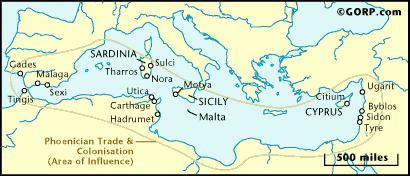 |
There were Phoenician settlements on the coasts of
Sicilia by about 1000 BC
(the time of King David of the Israelites, who referred to
the Phoenicians as 'Canaanites'). These were
often in the areas previously occupied by the Elymians, and
included
Sis
(or Ziz), the city called by the Greeks 'Panormos',
by the Romans 'Panormus', or modern Palermo).
The Phoenicians also established Drepanum (Trapani); Lilybaeum (Marsala); Eryx (Erice); as
well as Soloeis near the site of present-day Bagheria, and
Motya (later Mozia) on an island north of modern Trapani.
A question to ponder is whether Sis was so named
because it was on the island of
Sicilia, or whether
Sicilia simply meant 'the island where Sis is'.
By 814 BC, the Phoenician 'city-state' of Carthage
was founded at the site of the present city of Tunis in
Africa. Though founded by Phoenicians, Carthage became
an independent power in the development of northern Africa
and Sicilia, and
controlled much of western Sicilia
by 800 BC. There are indications that as early as the
Phoenician occupation, sulfur (zolfo, Sicilian
zulfuru) was being exported from
Sicilia to northern Africa. |
|
|
THE
CARTHAGINIANS
(800 ~ 241 BC) |
In the Phoenician language, 'Karthadasht' means 'New
City'. The name now used by historians is
Carthage. The term 'Punic', meaning 'Phoenician',
is used to described the city-state of Carthage, its culture,
art, as well as the language (a dialect of Phoenician) spoken there.
Carthage grew to be a power in its own right,
controlling the Mediterranean from the central portion around
Tunisia, west to France and Spain (that is to say, portions of the
regions today occupied by those nations).
From about 800 to 200 BC, Carthage had a
major influence on
Sicilia, though its
settlements were mainly coastal, and it began to be pressured by
another group of insurgents from the east, the ancient Greeks.
The native Elami, Sicani and Siculi adopted the Phoenician
alphabet, and during this period, in about 500 BC, the first
uniquely Sicilian coins were minted by Punic authorities at
Motya and other Carthaginian cities. The Motyan coin, with
its three dolphins, heralds a long tradition of three-sided
images representing Sicilia.
At about the same time, coins were beginning to be minted by the
Greeks at Segesta and other Greek-controlled Sicilian cities. |
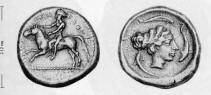
Motya didrachm coin ~ 425 BC |
|
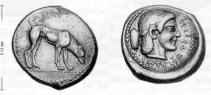
Segesta didrachm coin ~ 480 BC |
|
|
THE GREEKS
(800 ~
241 BC) |
Concurrent with the Punic development of
Sicilia's northwest in
800 BC, the ancient
Greeks established a presence on the island, heavily
colonizing the eastern shores and the interior previously
occupied by the Siculi, as well as the southern reaches of
the Italian peninsula. This was before Greece existed
as a unique nation, and here 'Greece' (their name for it was
Hellas) refers to a region rather than a country. It was the
area between Italy and Asia minor, where many independent,
powerful city-states such as Athens and Sparta vied for power.
The first Greek settlement in
Sicilia was in 735 B.C.E.
by colonists from Chalcis and Ionia, who
stopped at a bay of the Ionian Sea, near the foot of
a small headland peak they called
Ταύρος (Tauros,
or the Bull). |
 |
Although the group was made up mainly of Chalcidians,
evidently some of their party were from the Greek island of
Naxos, for Naxos was what they named their
first settlement, on the seaside lowlands. A town
inhabited by indigenous Siculi sat on the slopes near
the peak of Tauros. The Greeks eventually overtook the
town, which became known as Tauromenion,
today called Taormina.
Greek-Sicilian settlements were known as 'Siceliot' cities,
and often warred among themselves just as their forebears
did in Athens and Sparta. These wars often resulted in
complete destruction and leveling of the losing city-state,
and massacre, enslavement, or diaspora of its residents.
Some city sites lay abandoned for generations before being
re-settled and rising again, sometimes with the previous
name, sometimes with an altogether different identification.
As reported by
sicilia.it,
the main language of the Siceliots was the ancient Greek
variant, Doric, spoken mainly in the cities they
founded in eastern
Sicilia. The
contribution made by the Siceliot Greeks in literature was
remarkable. Some forms of 'Greek literature' actually
developed in
Sicilia: it would seem
that the Sicilian-Doric comedy, whose main exponents were
Epicarmo and Formide, served as a model for later classical
Greek (Attic) comedy of the fifth century BCE.
Many native Sicani, Siculi and Elami assimilated with the Greek settlers, and adopted their
culture. If these natives were in a Siceliot city that
was on the losing side in a war, they too were killed, sold
into slavery, or sent elsewhere. As an alternative,
many native Sicilians escaped to the interior of the island
to avoid them. This influx to the hills was to be a
recurring theme as settlements of Sicilians, invaded or conquered
by some new master, fled to the central expanses to avoid
subjugation.
Although the Greek presence in
Sicilia spanned the
lifetime of Alexander the Great (356 - 323 BC), Alexander's conquests were to the East and South of
Macedon. He never set foot in
Sicilia, though prior to
his early death he had laid plans to conquer the island.
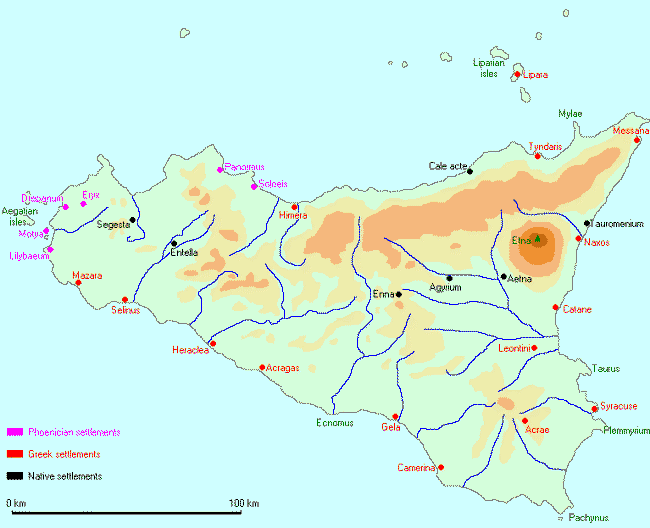
The map below, from 'LIVIUS
~ Articles on Ancient History', shows the
indigenous, Phoenician/Punic, and Siceliot cities during the
period. Some still exist with similar names, some have
been lost. Click on the map for a more readable image. |
|
 |
|
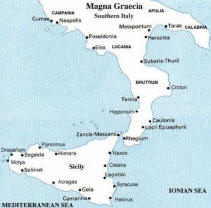
The Greek-colonized area
to the west of Hellas in the southern Apennine Peninsula and
Sicilia
came to be known as
Megara Hellas, or 'Greater Greece'. It was called
Magna Graecia by the Romans, who themselves were
just beginning to develop into a distinct culture.
Much Greek influence on Rome came from Magna Graecia in the
south, and contrary to the Romulus/Remus legends, Roman
historian Livy (Titus Livius Patavinus)
recounted that the city of Rome was founded by the Trojan
refugee Aeneas, who escaped to the Apennine Peninsula
and found the line of Romans through his son Iulus,
namesake of the Julian dynasty of Julius Caesar. The Greek
culture on the Italic peninsula began to decline by about 500 BC,
but the island Sicilia remained Greek
for another 240 years. However the region from
Neapolis (Napoli, Naples) south, comprised of Italy's
'foot' and the island of Sicilia,
were to be linked throughout history. Even today, that
region, the 'Mezzogiorno' is referred to as 'le due Sicilie'
(the two Sicilies).
Nowadays, many think of
Sicilia as an Italian
island, but in in these years, it was in great part Greek,
and many of the traditions, myths and great thinkers we
associate with ancient Greece were in fact
Sicilian.
Eventually, there were more Greeks in
Sicilia than there were in 'Greece' itself!
Sicilia had cities such
as Syracuse (now Siracusa), its name derived from the
Greek 'Sirakous', ('sirako', 'swamp'). It was founded
shortly after Naxos, by settlers from the Greek city of Corinth. The later
Roman philosopher Cicero called Syracuse "the greatest
Greek city and the most beautiful of them all".
Sicilia's most
recognizable icon, Mount Etna, was named for the
Greek goddess Αίτνα (Aetna), who bore
the Palikoi, children of Hephaistos, the
keeper of the gods' forge, inside the volcano. The
Palikoi were the gods of the thermal geysers around
Etna. |
By about 300 BC, the
Greeks began representing Trinakrias, or
Sicilia, on coins as a
triskelion, a three-legged figure, with the face of
Medusa at the junction of the legs. The triskelion
almost certainly represents the physical shape of
Sicilia: a natural
triangle with a cape accessing the North and Europe via the
Italic peninsula, from Messina (Capo Peloro); one
extending towards the East and Greece near Siracusa (Capo Passero); and
to the West, a cape at Lilibaeum (Marsala) or Capo Lilibeo,
which meant, literally, 'opposite Libya' or Africa.
Some express dismay over the use of
the 'horrible' face of the Gorgon to represent a nation,
however, there seem to be valid reasons. One is that
Medusa was, in some legends, a goddess of Libya,
whence may have come the first Sicilians, the Sicani.
Another is that in the classic Greek myth, Athena
turned the golden hair of the beautiful Medusa into
serpents. Perseus
later slew Medusa at Athena's command and
presented the head to her. The goddess attached the
head to her Aegis or shield, where it then became a
symbol to ward off enemies, who were turned to stone if they
looked upon the head. The symbol was then used to show
that its bearer was under the protection of Athena.
Since Athena was the patron goddess of Trinakrias,
the Medusa on the symbol of the island would ward off its
enemies.
I propose a third explanation: that
the head is not that of Medusa, but of Demeter (Roman
Ceres),
goddess of wheat, and the mother of Persephone (Roman
Proserpina) of Enna.
Persephone, as the wife of Hades, was the patroness of
birth, death, and rebirth; goddess of the changes of the
seasons. |
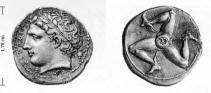
Sirakous (Siracusa) Coin ~ 336 BC
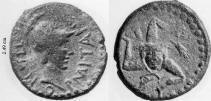
Panormos (Palermo) Coin ~ 241 BC
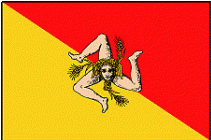
Autonomous Region of Sicily ~ 2000 AD
Variations of the Triskelion |
Since the triskelion has also been
interpreted as representing these cycles, could the symbol
of
Sicilia be the
representation of the mother Demeter protecting her daughter
Persephone, while showering her with the abundance of the
earth? Corns of wheat,
rather than serpents, are shown in some
early representations, as well as in the most recent flag of
Sicilia.
Sicilia was like a huge mixing bowl. Around
the edges, there were continual cycles of settlement, rich
commerce, war and disruption. This served sometimes to
homogenize the population of the coastal cities, and at
other times to eliminate whole groups of people. The
interior was less rich, but safer, if not from natural
dangers, from those imposed by man. Even in the
interior, there was probably a certain degree of ethnic
mixing, as poor Greeks or Carthaginians might also hide
there to avoid the latest war or purge that befell their
cities. But if remnants of the Sicani, Siculi or Elami
remained past ancient times, they would most likely be found
in the interior.
As a portent of future suppression, often the natives were used as laborers and
field workers for the more educated and prosperous immigrant
Greeks. The Greeks were resisted by the Phoenicians and
later Carthaginians who controlled the northwest portions of
Sicilia.
From 800 to 400 BC, conflicts were frequent between the
Greeks in the east and the Carthaginians in the west.
By 500, Syracuse had become the island's major Greek
city-state, with control over Akragas (now Agrigento),
Gela,
Catane (Catania), Himera (Termini Imerese), and
Messana
(Messina).
West of
Catane, the town of Mene, now Mineo,
was reportedly founded by one of the few native leaders of
Sicilia known from this
period, Ducetius. He was a native Siculan
born near Catane and educated in the Greek culture. He
united his fellow Siculi in a revolt against the
Greek-Sicilian cities in about 460 BC, and by 452 had
occupied Morgantina, Etna, and Motyon, and founded the city
of Palice, a site of geysers, and of temples to the
'Palici',
or
Palikoi gods.
The Siculi believed the Palici were sons of their
ancient Sicilian fire god, Adranus. Palice was a place of refuge for
many runaway Siculan slaves. Oaths taken in Palice
were said to be sacred, and breaking them reportedly brought
dire consequences, a theme to be repeated throughout
Sicilian history.
In 450, Ducetius was defeated
by the Siracusans and exiled to Greece proper. He
returned to organize Sicilia's
northern Siculi and founded Cale Acte east of
Messina, but when he died in 440 BC in a battle against the
Siracusans, his 'native Sicilian Empire' came to an
end. The Siculi kept no recorded history, so what
little is known of them was preserved in the writings of
their conquerors, the Greeks; in this case by Diodorus
Siculus, or 'Diodorus the Sicilian', ironically,
a Greek who was born, raised and died in
Sicilia. |
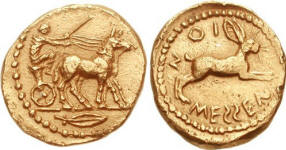 |
.. |
This was the first
gold coin to be struck in Sicily, possibly by
Ducetius in about 455 BC to fund his military
exploits. On the obverse, it depicts the
nymph Messana in a chariot, holding a whip and
the reins of a team of mules; the back shows a
rabbit and the inscription (starting at the
lower left and proceeding counter-clockwise)
'MESSENION', which was the Greek name
for the site now occupied by the city of
Messina. |
|
|
I have no explanation for the
rabbit; it seems a serendipitous coincidence that my name,
Coniglio, means 'rabbit' in the Italian
language ('Cunigliu' in
Sicilianu, 'Cunigghiu'
in some dialects). |
The influence of Greece on the culture of
Sicilia seems
immeasurable. Nor did Greek history and culture
develop without significant impacts from this robust island.
In Greek mythology, there are
numerous references to Sicilia:
the goddess Athena dropped the island of Trinakrias (Sicilia)
on
Enkelados, one of the Giants who had warred with the
Gods, and buried him under Mount
Aetna;
Persephone, wife of Hades and goddess of life, death
and rebirth, was born in Henna;
Daedalus, after his son Icarus' waxen wings were
melted by the sun, flew to
Sicilia and joined the
court of Kokalos, king of the Sicani;
Arethusa, the beautiful nymph, was transformed by
the goddess Artemis into a river that flowed underground
from Greece and emerged at Ortygia, an island
off the city of
Syracuse;
Hephaistos, the god of blacksmiths, craftsmen,
armorers and fire, had his mythical forge inside Mount Aetna,
according to Sicilian Greeks; the myth of
Medusa, one of the Gorgons, originated in Libya,
whence came the Sicani, and images of her head have adorned
insignia of Sicilia
for thousands of years.
Sicilia
played a role in ancient literature, as well.
The blind poet Homer wrote that during Odysseus'
long journey home after the Trojan war, he and his men were
held captive by the giant
Polyphemus of the shepherd
Cyclopes tribe of Sicilia.
Homer also tells of the dreaded
Scylla and Charybdis, the monsters guarding the ramparts of the Straits of
Messina between Italy and Sicilia,
were Odysseus' ship was destroyed. And the Aeolian
Islands, from which the Sirens and their songs
enticed Odysseus' crew, are
Sicilia's Isole Eolie.
Thucydides claims that the human Sicani tribes were
preceded on
Sicilia by the giant, somewhat mythical
Laestrygonians and Cyclopes.
The still-used phrase
"under the sword of Damocles" originated in
Sicilia during the time
of the Greeks. The tyrant of Syiracuse, Dionysius,
was a Sicilian-born ruler who extended his control over most
of Sicilia by the end of
his reign in 367 B.C.E. One of his advisors was the
courtier Damocles, also Sicilian-born. Once, to
demonstrate to Damocles the fear that Dionysius himself
felt, he had Damocles sit at dinner with him, under a sword
that was suspended by a single horse- hair. Since then,
anyone under threat or fear of uncertain fortune is said to
be "under the sword of Damocles".
Aside from the mythical
and legendary, in Sicilia, Greek philosophy and science were nurtured by
Archimedes, the father of invention, who was born
and lived his life in Sicilia. Among his
other contributions to science, this native Sicilian from Syracuse
was the first to develop the concept of
P
or pi, the ratio
between the circumference of a circle and its diameter, and
the basis of virtually all rational mathematics that
followed. He invented the water screw for lifting
water, and developed the concepts of buoyancy and fluid
pressure.
Aeschylus, the great Greek dramatist and author of
'Prometheus
Bound', was not born in
Sicilia,
but he
lived there when he developed methods of
production, acting, set design and other theatrical concepts
that revolutionized the art. Sicilian Greek artists
Kimon and Euainetos produced coins that remain
among the most coveted in the world |
|
|
The Greeks left a profound heritage on the island, including
the introduction of the cultivation of olives and grapes
(how would we make 'Italian' dressing without them?),
and the construction of classic Greek structures such as the
Amphitheatre at Syracuse and, in the Valle dei
Templi (Valley of
Temples) in Agrigento, the
Temple of Castor and Pollux. The the temples
are actually on a hill, but the area was called a "Val"
(region) by later-arriving Saracens. The Arabic word "Val"
is similar to the Sicilian "valle" (valley), so we have the
contradiction of the "Valley" of Temples being situated on a
hill! Near that Sicilian
hill also stand the remains of the largest
Greek temple in history, the Temple of Zeus.
Greek, though
Sicilianized, became the common language, and even after the Roman
conquest, when Latin was the 'official' language, Greek was
spoken by a multitude of Sicilians, well into the Middle
Ages. And though Greek power was on the decline while
Roman fortunes were rising, the impacts of the Sicilian Greeks on
Roman culture and civilization grew in the south and moved
northward, starting from the shores of
Sicilia and spreading throughout the Italian
peninsula. Sicilia,
which would one day be subjugated by Rome, was, during its
early Greek occupation, more civilized than the Rome of the
same time.
Carthage
continued its overtures on
Sicilia with attacks on
Himera and later on Syracuse, each led by different rulers
named Hamilcar. In 406 BC, the first Hamilcar's
admiral,
Nicia, conquered a high rampart in central
Sicilia, and built a
fort there, named after him: Castro Nicia (Fort of
Nicia, later to become Caltanissetta). However, the Siceliot
cities generally prevailed, and until 264 BC, most of
Sicilia was controlled by Greeks, except for the far
eastern reaches still held by Carthage. The ports and
larger towns were inhabited mainly by Greek colonists, their descendants,
and native Sicilians who had been assimilated. The
interior held those natives who could eke out a living without
incursions by outsiders. The main language spoken
throughout the island was Greek.
Sicilia, essentially, was
Greek. Then came the
Romans! |
|
|
THE ROMANS
(264 BC ~ 476
AD) |
Legend (and Livy) has it that
Aeneas, a Greek ally of Troy, fled to the Apennine
Peninsula after the
Trojan War and founded
Rome in about 1100 BC. The Roman version says
that
Romulus founded the city in 753 BC, and murdered his
brother
Remus in the process. Whichever version is
true, the fact remains that as Rome developed, a great
influence on its politics, its pantheon of gods, its ideals
and even the fashions worn by its citizens was Hellas
and its closest region to Rome, Magna Graecia,
including Sicilia.
Conversely, Rome's major
influence on the island Sicilia
did not begin until centuries later, in 264 BC, when Rome
began hostilities against the Carthaginians there, waging the
First Punic War. After twenty-three years, by
241 BC, Rome had won the war, and
the island
Sicilia became the first external province of the
Roman Empire.
While 'Rome' is considered by many to
be synonymous with 'Italy', and since
Sicilia today comprises an
autonomous region of Italy, some may believe that
Sicilia remained under
Roman or 'Italian' rule for most of its history. The
facts speak otherwise. After the seven-hundred or so
years of Roman dominance, Sicilia
saw a wave of rulers from various other cities, states, or
nations for nearly one and a half millennia, before becoming a part of
the "reunified" nation of Italy. That is not to say
that the Romans' stay did not have ineradicable effects on the
people, the culture, and the very fabric of
Sicilia.
With the Romans came their
language, Latin. Official, or 'High'
Latin was spoken by the ruling classes, the nobility and
privileged 'cives', or 'citizens'. The common people,
that is the subjects or slaves of Rome during this period,
continued to speak Greek. A local tongue developed
slowly, with nuances of ordinary, 'vulgar'
Latin.
Because of the closeness of the lower
Appenine Peninsula to Sicilia,
and the numerous social and political connections between
the island of Sicilia
and the region of the "two Sicilies"
(not the least of which was the original influx of Siculi
from the mainland), the language that developed throughout
the region, including the southern mainland, was very
similar to Sicilian. Today, Calabrian, or
Calabresi, is virtually a co-dialect of Sicilian.
. The stage had been set for Rome's
first expansion outside the Apennine Peninsula in 288 BC,
when the Mamertines, southern peninsular
Campanians who were former mercenaries of
the Greek king of Syracuse, captured the strategic Siceliot
town of Messana (now Messina), killing most of its
citizens and making it a raiding base. After twenty years,
when the Greeks tried to suppress the Mamertine activity,
the raiders appealed to both Rome and Carthage for help.
When Carthage sent troops, Rome reacted by invading
Sicilia, and the First
Punic War between Rome and Carthage began in 264 BC.
The Carthaginian general Hamilcar Barca (father of
Hannibal) was successful in his battles on land in in
Sicilia, but the
Carthaginians lost at sea, and by 241 BC, Rome had not only
won the war with Carthage, but weakened the control of the Greeks.
Rome's position was solidified after the Second Punic War (311
BC). Because Sicilia had
sided with Carthage, Rome conquered and subjugated the
island, which thus became Rome's first external province.
During the Third Punic War, fought outside of
Sicilia, Rome further weakened Carthage and
eventually eradicated it.
The Roman Empire was in
the midst of major expansion, and needed wheat, both to feed
and quiet the populace at home, and to support its far-flung
armies. During this period,
Sicilia
became known as the granary of Rome, for its heavy
production of grain. Grain grew
easily, with little oversight by landowners and little
ingenuity required by the field hands.
Sicilia's wheat was, and
still is, grown during the winter to avoid the blazing
sun of summer. This winter wheat, or durum,
is dense and hard and can be stored for long periods or
shipped on equally long voyages, qualities that created a great demand for
it in the ancient world.
The Romans
wreaked ecological havoc, felling thousands of the island's
trees to build ships for their navy, to gain farmland, and
even to export lumber for construction of buildings in Rome
itself.
Sicilia became a 'sub-colony', and the
non-Roman inhabitants became slaves or servants, living in poverty.
Slave revolts broke out periodically, but were brutally
suppressed. In 63 BC, Roman general Pompey sacked
Jerusalem and transported 30,000 Jews to
Sicilia as slaves. The
role of slave and free Jews, and even of early Christians is
not well recorded during the period of the Roman occupation of
Sicilia; however it is
known that Saint Paul preached in Siracusa on his way
from Judaea to Rome.
Sicilia
was evidently particularly
receptive to Christianity, perhaps because of the large
slave population, and among the earliest Christian martyrs
(circa 250-300 AD) were
Santa Agata of
Catania and
Santa Lucia of Siracusa. |
|
During this period, wealthy Roman citizens had 'latifundia',
large estates surrounding their villas, in
Sicilia. The estates were vast, and the
villas were in the Roman design with large buildings, baths and halls with Roman mosaic
floors and walls, such as the Villa Romana del Casale
near the present town of Piazza Armerina.
Often the Roman nobility and upper classes enslaved the
Sicilian Greek natives as servants in the villas and workers in
the fields; cruel class distinctions that would last for
millennia. The latifundia would eventually become the
huge holdings, 'feudi', or fiefs of the medieval barons
of ages to come. Thus,
he heritage left by
the Romans can be summed up in this way: "land grabs, deforestation, and
subjugation." |
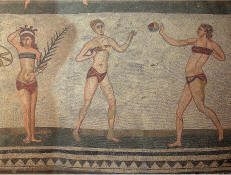
'Bikini room' at Villa Casale, 325 AD |
|
While rich individual Romans
built luxurious estates such as the Villa at Casale, these
were private enterprises. The vast public works of
aqueducts, roads and temples that were iconic in Rome were
not undertaken in Sicilia. Rome used
Sicilia as its
breadbasket,
and in doing so enslaved (that is, those that they did not
kill) most of its Greek-Sicilian and remnant Carthaginian
populace. Rome also imported to
Sicilia tens of thousands of slaves from other
conquered lands. The more slaves, the more wheat was
grown, to ship to Rome and its military legions. And
just as Sicilia became
the first colony of Rome, it was the first place to have
popular revolts against her, in 135 BC. when the slave
Eunus led thousands in a revolution which marched from
Enna to Siracusa, and again in 104 BC when the slave
Salvio instigated an uprising in across the island.
Needless to say, both revolts were violently and mercilessly
put down. Some of Salvio's rebels were promised they
would live if they surrendered. They did so, only to
be sent to Rome, to be torn apart by wild animals in the
Coliseum's spectacles.
During this period Rome
appointed governors, each of whom would oversee
Sicilia for a one year
term, ruling from Siracusa. The great Roman lawyer
Marcus Tullius Cicero spent time in
Sicilia in the first
century BC, and admired the land and its people. A
contemporary of Cicero was the governor Gaius
Verres, who managed to serve for not one, but three
years, during which, according to Cicero, he plundered and
raped his way through Sicilia,
appropriating untold treasure which he sent back to Rome for
his personal collection. He stole priceless statues of
Greek gods from Agrigento, Termini Imerese and Segesta, and
in their place had statues of himself and his family erected
at taxpayer's expense. In her book Sicily -
Three Thousand Years of Human History, Sandra
Benjamin states: "Though he [Verres"] showed great
talent in stealing from the Sicilians, he was just one such
official in a long line that extends to the present day."
When
Rome's first dictator Gaius Julius Caesar was killed
in 46 BC, his great-nephew and nominal successor
Octavian fought a war over his succession, with
Pompey and his allies. The war was fought and won by
Octavian in Sicilia and
the seas around it, and Octavian emerged the victor.
He later was known as Augustus Caesar, the first to
use "Caesar" as a title, meaning "Emperor".
More and more often, Rome
sent patricians and politicians to manage and populate
Sicilia's larger cities.
These cities were taxed according to the favor they had
curried with Rome. To the residents of those that had
supported Rome in its conquest of
Sicilia, Roman citizenship was granted. Not
so for cities that opposed Rome, or for the pre-existing
Sicilian populace, whether they be "native" Greeks;
aboriginal Elami, Sicani or Siculi; or slaves brought in
from the far reaches of the empire. Many of those
"non-citizens" were relegated to the small interior towns
and the lonely hills. The Roman elite, including many
absentee landlords, slowly absorbed
the plots of most small farm-holders, growing wheat almost
exclusively on ever-larger tracts, the latifundia.
Thus, northerners from the Apennine Peninsula ran the richest
cities and the vast farms, while the Sicilians took orders
and did the heavy labor. Another theme that was
destined to be repeated.
It is said
that the period of Roman dominance in Sicilia
represents the longest period of 'peace' (if slave
revolts are not counted) in the history of the island, as
foreign incursions were few after the Second Punic War.
Yet for many, it was the peace of subservience and
obedience. Slaves were generally treated
harshly and fed poorly, and sometimes their recourse was to
become 'briganti' (brigands) in small groups that hid
in the hills and sustained themselves by poaching, stealing,
and robbing whatever and from whomever they could. This 'brigandage'
was to haunt the hills of Sicilia
into modern times. Often the citizenry was fearful to
report or punish the brigands, who were owned by powerful
landlords, in fear of reprisal by their owners. This
practice of authority in essence condoning the brigandage
also persisted, with variations, for generations.
Eventually, there grew to be two types of brigandage.
One was simple banditry, into which which some
men felt forced, in order to survive in the face of brutal,
unjust authority. These bandits were outlaws without
involvement or interaction with the "rightful" authorities.
The other form of brigandage was that which eventually
developed into the
Mafia, which used threats
and force to serve its own purposes. It infiltrated and
often was encouraged and even directed by elements of Sicilian
authority: the nobility, the Church hierarchy, or the police.
And the great
estates, the latifundia, would characterize
the countryside for a millennium and more, from their
ownership by Roman nobles until the twentieth century, when
descendants of medieval nobility continued to own vast
tracts, often poorly managed or even lying fallow.
Individual or family ownership and management of small
tracts of land, or 'smallholding' was virtually
non-existent.
While Latin
was used by the establishment, ordinary folk throughout the
island still spoke Greek as their everyday language.
The strength of Greek influence was reflected in the fact
that while its masters were Roman, the bulk of
Sicilia's citizens
followed Greek customs, spoke Greek, and considered
themselves Greek. One of the greatest Greek historians
was Diodorus Siculus (Diodorus the Sicilian), born in
Agyrium (Agira), who wrote a
Library of World History in about 60 BC. The
remains of the Library of World History are the
largest surviving corpus of any ancient Greek historian.
Vernacular language was tinged by the previous languages
spoken by the masses, and by their unique local customs and
culture. These variations eventually became
identified, each with a particular region, as a 'dialect' or
language of that region. So the beginnings of the first 'Romance
language' appeared in the mixture of Latin and Greek spoken in
Sicilia, with roots in the now forgotten Sicanian,
Siculan, and Elymian tongues, as well as sprinklings of
Phoenican. The most persistent of these
effects may be in names of places: Erice was the Eryx of the
Elami; Enna the Henna of the Sicani; Mozia and Lilibeo
were the Phoenicians' Motya and Lilibaeum; and Trapani was
Drepanon, Greek for 'sickle', the shape of its harbor, while
Messina was the Greek's Messana.
Dozens of other examples exist.
The language of the masses eventually developed into a
version of the modern Sicilian language. That
language, sadly, is not the 'official' language of
Sicilia, since the
Italian government now requires that 'Italian' be taught in
Sicilian schools. Young Sicilians now speak 'Italian',
and 'la lingua Siciliana' (the Sicilian
language) is an anachronism, spoken by the elderly, and by
tourists from America and other lands; descendants whose
forebears brought the Sicilian tongue with them when they
emigrated. |
|
|
THE BARBARIANS
(476 AD ~ 535
AD) |
|
By about 396 AD, the great Roman Empire began to decline and
break up, besieged by barbarians (so-called because
they wore 'barbi', or beards) including the Vandals and Ostrogoths. The Empire split into a Western Roman
Empire and into an eastern, or Byzantine Empire,
which encompassed much of the ancient Greek lands in Hellas
and Asia Minor.
Sicilia remained under the
domination of the Western Empire for a few more years, but
by about 476, Germanic barbarian tribes like the Heruli
and the
Vandals overtook Sicilia.
This was the start of Europe's 'Dark Ages',
which would last until 800 AD. In 493 AD,
Theodoric the Great and his
Ostrogoths swept over and controlled the island.
According to
Vincenzo Salerno, ' Historians now
recognize that many of the invasions in the declining
Western Roman Empire were actually not wars but reasonably
peaceful migrations which did not necessarily disturb the
existing population, at least initially. In certain isolated
(rural) communities the change of government may not even
have been obvious for years or even decades. This appears to
have been true of the Ostrogoths' migrations into Sicily'. |
|
|
THE BYZANTINE
GREEKS
(535 AD ~ 827
AD) |
The culture of the Eastern Roman
Empire, the Byzantine Empire, was at the same time
Greek and Roman: it was Greek culture that had been adapted and
overtaken by the Romans, but returned to its roots in the
Eastern Mediterranean. They called themselves
'Romans' but spoke Greek, although some Latin was also
spoken. Linguistically and culturally, their society was
not very different from that of the contemporary Sicilians.
In 535 AD, Sicilia, which had been part of the Western Roman
Empire when it fell, was recaptured from the Ostrogoths by
general Belarius of the Byzantine Empire, then ruled by
Emperor Justinian I. Thus, while Western
Europe was under the shadow of the Dark Ages until Charlemagne
unified it in 800 AD, Sicilia
remained 'civilized' under the Byzantines. The Byzantine
Empire was a Christian
empire: it was the Roman Empire, whose capital was moved from
Rome to Byzantium (later Constantinople, now Istanbul) by
Roman Emperor Constantine the Great. At
first, although Christian, it displayed religious tolerance for
Jews, pagans and Muslims. Its major religion grew into the
Orthodox Christian religion, while the Christian remnants of
the Western Roman Empire followed the Latinized, or Roman
Catholic version. Sicilia
during this time was Orthodox.
Vincenzo Salerno
states 'Not
all Sicilians were Christians. Sicily had numerous Jewish
communities, even in certain small and remote towns. In
Sicily, the Jews dominated certain fields, particularly some of
the textile trades. Though (largely by choice) they lived in
certain districts, the Jews were not very different, socially
speaking, from the Orthodox Christians of Sicily.' Justinian's
law was the basis for many legal systems still used today, but
eventually his defense of Christianity led to intolerance and
persecution of 'heretics', including pagans and Jews. |
|
|
THE SARACENS
(827 AD ~ 1072
AD) |
|
Saracens,
Moors, Arabs - the rulers of
Sicilia during this period, at the end of
the 'Dark Ages', were called by various names, applied
generally to the peoples united under the practice of
Islam, and those who spoke Arabic.
Because they included both dark-skinned Caucasians and
sometimes negroes, 'Moor' often is taken as
synonymous with 'black', but the equivalent Sicilian term
'Mauro' evidently was used to describe
appearance, not racial background. The two-and-a- half
centuries of Arab occupation of
Sicilia were to bring profound influences on
agriculture, science, engineering, cuisine, and social
interactions. |
|
In 827 AD, over ten
thousand Arab and Berber troops landed at Cape Granitola
near Mazara in the western part of the island.
The siege was a result of the Byzantine admiral Euphemius' offering the governorship of the island to
Ziyadat Allah, the Aghlabid Emir of Al Qayrawan (in Tunisia)
in exchange for his support against the Byzantine emperor.
The practical result of
the 'Arab assistance' was that the Arabs eliminated
all the
Byzantines (including Euphemius), and by 965 AD the Moors had completely taken over the island
of Sicilia, which became
known as the
Emirate of Sicily.
Panormos became Bal'harm (it is now
Palermo);
Enna became Kasr' Yanni,
then Castrogiovanni, and is now once again
Enna;
Marsala is from the Arabic Mars' Allah,
Port of Allah. Castrum Niciai, where the
Moors
reconstructed the castle of Pietrarossa
(Red Rock), was the 'Fort of
Nicia',
a Carthaginian admiral who invaded Sicily. 'Fort' in
Arabic is 'qalat', and the Moors thought
Niciai sounded like the Arabic word 'nisaà'
(which means 'women'),
so it was renamed by them Qalat al Nisaà
(Fort of Women), which today is called Caltanissetta. |
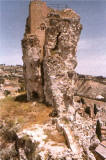
Ruins of Pietrarossa |
|
The Arabs introduced
irrigation qanats or canals, cotton
agriculture, and the silk industry. They introduced
yasmin, or jasmine (gelsomino) for
its sweet-scented flowers and use in tea. They also brought
asparagus, oranges, lemons, limes, figs, dates, spinach and
eggplant, rice, and sugar cane, all of which in turn
affected Sicilian cuisine. The Sicilian word for a
fried dessert, sfinci, is from the Arabic
sfang, fried dough; the Sicilian
aranciu (orange) and the English word for the fruit
are from the Arabic naranj. The Sicilian
word for artichoke, carciofu, is of Arabic
origin (al’qarshuf),
as is the plant itself, as well as its relative, the
thistle artichoke, or cardoon.
Spinaci or spinach is from the Arabic
esbinakh; limone (lemon) from
laimun; riso (rice) from ar-ruzz;
and cotone (cotton) from
qutn. Many of these words, somewhat modified,
have since been absorbed into the English language.
A
sweet Sicilian confection with sesame seeds and almonds (torrone,
in Italy) is cubbaita, from the Arabic
concoction qubbayt. The
Arabs made sharbat (sherbet, sorbetto)
from the snows of Mount Etna, flavored with the essences of
flowers and citrus ('Italian ice'!). The name
of those beloved
giuggiulena
(sesame seed) cookies is from the Arabic
giulgiulan;
and babbaluci, or snails, are babus
in Arabic. Magazzino, "warehouse" or
"stockroom" is from the Arabic mahzan.
The quintessential Sicilian dessert, cannoli,
is the plural of cannolo (little cane), so
called because its shape (and taste) emulated the Arab sugar
cane. The
Sicilian custom of breaking bread, rather than
slicing it with a knife as in Italy, is an Arabic
heritage.
The Arabs also started organized
the tuna
fishing or 'hunts' which became an important industry, in
the Mediterranean Sea, near the island.
These tradition-steeped hunts still take place at a few
sites near Sicilia's
west coast. The tuna hunt is la mattanza,
from the Spanish for 'the killing'. Its leaders are still
called rais (Arabic for 'chief'), and the
fishing parties use chants so ancient that the fishermen
themselves do not know the meaning of some of the words,
probably archaic Arabic.
Perhaps one of the most
enduring contributions of the Arabs was the introduction of
thoroughbred horses, and promulgation of breeding methods
for the animals, for which Sicilia
is world-renowned to the present day. The prototypical
Sicilian horse is the San Fratello, a strong,
powerful breed, usually black or bay, known for its
endurance.
Like Caltanissetta,
place names beginning with 'Calta' are from qalat, the
Arabic word for 'fort', as in
Caltabellotta, Caltagirone, Caltavuturo,
and several others. The word zero, in Sicilian
and English, is from the Arabic sifr;
ragazzu and ragazza, meaning 'boy' and
'girl',
are from the Arabic raqqas, meaning
'messenger'. The Sicilian word tazza, meaning
'cup' and zuccheru,
as well as its English translation sugar, are derived
from Arabic. The Arabic kameesh (shirt)
became camisa in Sicilian, and meskin
(poor person) became mischinu. And the Arabic word mahias,
meaning 'bold man', is believed by some to be the origin of
the Sicilian word
mafia.
In part due to the
practice of male polygamy, the population of
Sicilia doubled under
Arab rule, and by 1066, about half its citizens were Muslim.
Arabic was widely spoken and it was a major influence on the
developing Sicilian language.
Muslim practices dating from the medieval Arab domination of
the island continued to be reflected in Sicilian nuptial
customs, particularly as they existed before the twentieth
century. The church may have eventually supplanted the
mosque, but the idea of a young bride being betrothed,
without her consent, to an older man she barely knew, was
remarkably similar to the marital traditions that still
exist in
Saudi Arabia and several other Muslim countries.
|
|
Arabic art and
architecture
from this period does not remain in many places in Sicilia.
However, the next conquerors of the island, the
Normans, were great admirers of the Arabs.
They tolerated and even encouraged Arab artists
and scientists, and incorporated Arabic
principles in their architecture, much of which
survives. A remnant of Arabic architecture
was Kas'r Iahia (Castle of John)
in Bal'harm, which was rebuilt in
the Palermo of the Normans as the church
San Giovanni dei Lebbrosi (St. John of
the Lepers), retaining the Arabic-style
cupolas. |
. |
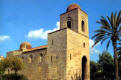 . .
St. John of the
Lepers |
|
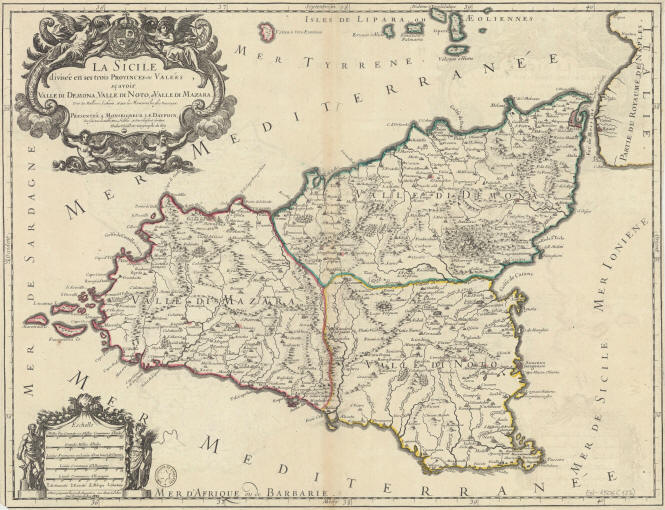
The map below is from a
later time period, but it shows how the
influence of the Saracens lasted for centuries
after their fall from power. The Arabic
word pronounced "Val" means "region", or
"district". Sicily was divided into
three Vals: Mazara, Noto and Mona. The
Vals were dilineated by water; either the
coastline or a river. Because of the
similarity of "val" to the Sicilian word "valle"
(which means "valley"), these three districts or
early provinces began being called Valle
di Mazara, Valle di Noto
and Valle di Mona or Valle
di Demona. They were clearly not
valleys, as valleys are bounded by ridge lines,
rather than by waterways.
In 1709, when
this map was published, the Valle
were still the major subdivisions of Sicily.
. |
|
 |
|
|
|
THE NORMANS
(1061 AD ~ 1194
AD)
Inroads by the
Church and the British |
|
The name Normans
literally means Norsemen, or Men from the North.
It was applied to the Scandinavians, including, in
some cases Vikings, who raided, conquered and settled
much of Europe during and after the Dark Ages.
One stronghold of these fair-haired, fair-skinned
transplanted northerners was Normandy, in what is now
France, where through intermarriage they acquired Frankish,
Roman, and Celtic blood. Though descended from
Scandinavians, they spoke French. From Normandy, they
made excursions to other parts of Europe, west to the
British Isles, and south to southern Italy, where Roger de Hauteville
became
Ruggieró d'Altavilla Conte di Calabria (Roger de
Hauteville,
Count of Calabria), on the "toe" of the peninsula.
The de
Hauteville family were important leaders of the Normans, and in 1061, landed a small armed
force on Sicilia.
By 1066, while his cousin William the Conqueror was
winning the Battle of Hastings to conquer Britain,
Ruggieró (Roger) and his brother Roberto Guiscardo
(Robert the Cunning)
were well on their way to controlling
Sicilia. This took place with the blessings of the Papacy
(the Latin, Catholic faction of the
Christian church), which encouraged the suppression of Islam
and Orthodox Christianity. Thus,
although
Sicilia was not actively involved in the Crusades, Ruggieró's
exploits were a prelude.
A
history of the rulers of Sicilia
starting with this period might also properly include 'THE
POPES'. Medieval Europe had a 'tripartite'
organization consisting of the Roman Catholic Church,
the nobility, and 'citizens'. ('Citizens'
were only a privileged
few: peasants, serfs and slaves had no franchise). In
many instances the rulers of nations or states were vassals
of the popes, doing their bidding for heavenly rewards, and,
more practically, for earthly gains. It was important
to the papacy that Sicilia,
then considered essentially a part of Africa, be brought
into the European (papal) sphere of influence.
Further, the Church owned vast lands and continually strove
to add to its holdings, causing frequent disagreements
between popes, kings and barons about to whom the land
actually belonged (that is, who could use it, tax it, rent
or sell it).
|
.
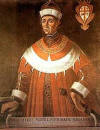
Roger the First |
.. |
In 1086, Ruggieró conquered Pietrarossa in Caltanissetta,
where he established
the Royal
Abbey of the Holy Spirit,
and by 1091, the
Normans, led by Ruggieró and Roberto, had complete dominance over the
island. Ruggieró introduced, not always with
Papal approval, the most enlightened, tolerant,
and cosmopolitan period in the history of
Sicilia. This is
not to say that such benevolence extended to all, since the
period also saw the introduction to
Sicilia of the European
feudal
system, which would last over 750 years. Ruggieró
embellished Caltanissetta with buildings, and he and the
other Normans endowed their retainers with rich gifts
throughout
Sicilia:
feudal fiefs and parcels of land, the latifundia of
old, given or leased to vassal
nobles for their military support, and |
|
cultivated by
the lower classes,
though strict serfdom did not exist. Land
was inseparable from the concept of feudalism,
and the struggle for ownership of the land by
rulers, vassals, and even the Church was to
shape European states for centuries, and effect
Sicilia
possibly most of all.
Under Roger, Arabs in the cities, who
had often negotiated terms of surrender with the Normans,
commonly retained their culture; their mosques, kadis
(judges), and freedom of trade. But those in the
country became serfs in the new system, most likely along
with indigenous Sicilians descended from the
servants and slaves of the Romans. The conditions and
prevalence of serfdom were generally less severe in
Sicilia than in Europe
proper, and in general, during the Norman reign, freedom
of speech and literacy came to be considered every
Sicilian's birthright. |
Ruggieró became known
in Sicilia as Ruggieru Primu (Roger
the first) or Gran Conte Ruggieru (Grand Count
Roger) and his brother as Duca Rubertu il Guiscardu
(Duke Robert the Cunning). Ruggieró tolerated the
Orthodox churches (Greek), but to mollify the papacy, he created new Latin-rite
dioceses at Siracusa, Girgenti (Agrigento) and
elsewhere, nominating the bishops personally; and he
changed the diocese of Palermo from 'Greek' to 'Latin'
(Orthodox Christian to Roman Catholic). In the
rest of Europe, vassals swore fealty to kings who
'ruled' over regions where their barons and dukes, in
fact, determined and administered the local laws.
Consequently, uniform rule over a large territory was
non-existent. Thus, the death of kings or major
vassals often threw their holdings into disarray and
decline. Ruggjeró's signal accomplishment was to
create the world's first nation-state. He ruled
Sicilia and the
southern Italic peninsula through his law, which
was administered in his name by his barons or princes.
Inevitably, however, that control was slowly eroded
during the reign of his heirs, by pressures from various
factions including the the Popes (through their agents,
often English subjects), the barons, the Lombards, the
French and others.
Ruggieró died in 1101 and his
wife Adelesia (Adelaide) held power until his son
Ruggieró
II reached maturity in 1112. A measure of
Count Ruggieró's success at nation-building was the
smoothness with which the country continued to be
administered by his heir, and
Sicilia was to become a model for future
successful nation-states. Ruggieró II
ruled for 42 years. During that rule, in 1139, he
was declared by Pope Innocent II as Re di
Sicilia (King of Sicily), establishing the island as
an independent Regnu (Kingdom, Realm) for the
first time. His reign established a true Sicilian
nation, inhabited by a 'Sicilian people'. During this
time Sicilia at last
became identified as a region of Europe, and not Africa,
as it was under the Moors, or a part of Asia, as it was under the
Byzantine Greeks.
Ruggieró II's kingdom grew to
include portions of the
Balkans, northern Africa, and the islands of Malta and
Corfu. The Kingdom included Napoli (Naples)
and the southern Italic mainland, where Ruggeru
eventually took control of Calabria and Apulia
(Puglia), and considered himself 'Ruler of
Sicily and Italy'. Thus the southern
peninsula, with all the
other holdings was part of
Sicilia, and with
it, was called the Mezzogiorno. Ruggieró II's
kingdom was then known simply as 'il Regnu' (the Kingdom).
References here to the Sicilia
of this time therefore include Napoli, which was part of
the Kingdom of Sicily, and was ruled from
the capital at Palermo. Ruggieró
II supported numerous scholarly projects, including the
Saracen scholar
al Idrisi's
Book of Roger, considered one of
the greatest geographical achievements of the Middle
Ages. One concept espoused by the book was that 'the Earth
is round like a ball': a revolutionary idea at the
time. Men of letters from many lands were always
welcome at court.
Another fallacy put to the lie by al-Isidri is
that "Italy" invented macaroni, after
noodles were brought back from China in 1295 AD by
Marco Polo. But the earliest evidence of a
true macaroni occurred at the juncture of medieval
Sicilian, Italian,
and Arab cultures. In his Book of Roger,
completed in 1154, al-Idrisi referred to
Sicilian
vermicelli nearly a hundred and fifty years
before Polo returned from China. This twelfth-century
Sicilian pasta, the earliest clear Western reference to
macaroni, was exported to Calabria,
and commercial contracts from Genoa between 1157
and 1160, recorded by the notary Giovanni Scriba,
show large imports of Sicilian
pasta.
Sicilia's
multicultural society and Ruggieró II's administration
were unique at that time in history, as Norman
administration co-existed with older Arab institutions,
and official documents were published in Greek, Latin,
Arabic and even sometimes in Hebrew or Norman French. Arabic-speaking
subjects, whether converted Arabs, Jews or Greek
orthodox, enfolded Latin vernacular, or "vulgar Latin"
into the common tongue, further evolving the first
'Romance language', Sicilian.
|
|
Thus, while northern and central Europe were under the
shadow of the 'Dark Ages', Sicilia
was, literally, an island of culture, diversity,
tolerance and civilization, as the era
witnessed a proliferation of cultural activity.
The 'poets school', of which Ruggieró
II was a patron, was frequented by many famous
writers.
The most prominent of these was Cielo D'Alcamo (Michele or 'Michael' of
Alcamo), who reportedly wrote the
most beautiful Medieval love poem, 'Il Contrasto'
('the Quarrel'). The school was to develop into
the influential 'Sicilian School'. The first
sonnet, whose invention is
attributed to Sicilian Giacomo da Lentini, was
composed in the Sicilian language. |
|
Author and critic Anthony Di Renzo summarizes
Roger II's exceptional life as follows:
Roger II, Sicily’s greatest king, died 860 years ago on
February 26 [1154]. The nephew of Robert Guiscard and son of
Count Roger I, Roger II came to the throne at the age of
nine and wrested control from his regent when he was
sixteen. Crushing all opposition, Roger ruled Sicily until
his death at the age of fifty-eight. Contemporaries claimed
that he accomplished more in his sleep than other people did
when awake.
Raised by Greek and Muslim tutors and secretaries in an
island populated by Arabs and Greeks, Roger was more
sophisticated than his hard-bitten, rough-and-ready Norman
ancestors, most of whom were illiterate. Through shrewd
diplomacy and sheer audacity, he outmaneuvered his lunkish
Hauteville cousins and annexed Apulia and Calabria. He still
lacked a royal title so when Innocent II and Anacletus II
squabbled over the papacy, Roger supported the latter in
return for a coronation on Christmas Day, 1130 in Palermo
Cathedral. When Anacletus died, Roger defeated Innocent’s
army the following year, took Innocent prisoner, and forced
the pope to confirm his position as King of Sicily and
overlord of Southern Italy. In a mosaic in Martorana Church
Roger had himself depicted like a Byzantine emperor, being
crowned by Christ.
Roger built and beautified churches, most notably the
Cathedral of Cefalù, but most of his subjects were Muslims
and Jews, who adored him. Much to the Rome’s dismay, Roger
was a paragon of religious tolerance. His scarlet and
gold-embroidered mantle was inscribed in Arabic and dated
according to the Islamic calendar. His kitchen was staffed
with Sephardic chefs, who kept the Christian king kosher. He
flirted with Greek Orthodoxy, whether out of piety or spite.
To project divine munificence, Roger kept an ostentatious
court. Behind the scenes, however, he counted every penny to
create an efficient civil service and a powerful navy. His
fleet captured every North African port between Tunis and
Tripoli, seized Malta and Corfu, harried the coasts of
Greece, and abducted numerous Theban workers to staff
Palermo’s silk factory. The king steered clear of crusading,
but his ships sailed up the Bosphorus and impertinently
fired arrows into the Byzantine Emperor’s garden.
Roger, however, valued peace more than war. Known for his
intellectual curiosity and his regard for learning, he
presided over Europe’s most glittering court among scholars
from both the West and the Arab world. He discussed
everything under the sun with philosophers and
mathematicians, doctors and geographers, in French or Latin,
Arabic or Greek, and he appointed a commission to collect,
sift, and assemble all available knowledge about the
physical world. After fifteen years, the commission produced
“The Book of Roger,” which John Julius Norwich rightly calls
“the greatest geographical work of the Middle Ages.”
“The earth,” it begins, “is round like a sphere.” And for
forty years Roger made Sicily its center. When he finally
died of overwork, he was buried in Palermo Cathedral in a
porphyry tomb fit more for an emperor than a king, dressed
in Byzantine royal robes and crowned with a tiara hung with
pearl pendants. His third and last wife bore him a
posthumous daughter Constance, who married Emperor Henry VI.
Roger’s grandson Frederick II (called “Stupor Mundi,” the
Astonishment of the World) would rule the Holy Roman Empire
from Sicily. Many historians consider his reign the
beginning of the Renaissance.
|
|
With Ruggieró II's death
in 1154, the Kingdom passed to his heirs, some abler than
others. His son Guglielmo Primo, in Sicilian Guglielmu
Primu (William I) was
known as "William the Bad", and his grandson Guglielmu
Secunnu
(William II) was called "William the Good", more
to differentiate the two than because of any merits of the
second. Under the influence of his advisor, the
English churchman Walter of the Mill (Gualtieri
Ofamilio), William II married
Joan Plantagenet,
sister of the future King Richard Lion-Heart, and daughter of
Henry II of England and
Eleanor of Aquitaine, further involving
English influence in Sicilia's
affairs.
The realm was
essentially ruled by Walter of the Mill, as
'Emir and Archbishop of Palermo', but Guglielmu
II was responsible for the construction of Sicilian
marvels including the
mosaic-encrusted
Basilica of Monreale, a world-famous cathedral near
Palermo. When he died without an heir, the
barons of Sicily installed an illegitimate
grandson of Ruggieró II, Tancredo II, as their king, and imprisoned Guglielmu II's wife,
Joan of England. This led to
invasion of Sicilia by
Philip Augustus of France, and shortly afterward by his
Crusader ally Richard Lion-Heart, who demanded the release
of his sister Joan. After capturing and sacking Messina,
Lion-Heart negotiated with Tancredi for Joan's release.
The terms included the promised betrothal of
Tancredi's daughter to Lion-Heart's nephew, as well as a
gift from Lion-Heart to Tancredi: a sword reputed to be
King Arthur's Excalibur. |
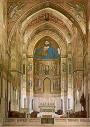
Monreale Basilica

Lion-Heart's Arms |
|
Tancredi and Lion-Heart's agreements were moot, because in
1194, Ruggeru II's daughter Constance (Costanza), claimed
the Sicilian throne by right of descent, and married Holy Roman
Emperor Henry (Enrico) IV. The reign of
Sicilia passed to his
Swabian family, the Hohenstaufens. But to this day, the Normans and their predecessors the Moors
are memorialized in the common talk of the Sicilian people:
if a girl or woman is swarthy, with dark eyes and black
hair, she is called 'maura' or 'morra' (Moor); if she is pale,
with blue eyes and light hair, she is called 'normana'
(Norman).
Though his Sicily was to be ceded to and dominated by
numerous rulers, some from the island itself, but most from
foreign capitals, Roger established the boundaries of
Il Regnu as they would be recognized over the next
seven hundred years; so beginning with the reign of the
first Roger, for eight hundred years before the formation of
the country know known as Italy, in one form or
another there was a Kingdom of Sicily. After
the Normans, it passed first to the Hohenstaufens,
whose crest is shown at the right. |
 |
|
|
GERMANY (THE
SWABIANS)
(1194 AD ~ 1266
AD) |
|
In 1194, the
region today known as
Germany was comprised of several duchies, one of
which was Swabia. The Holy Roman Empire
included these German-speaking states, and its ruling family
was the Hohenstaufens of Swabia.
The Dukes of
Swabia became Kings of Germany during the rule of
the distinguished Frederick I "Barbarossa" ("Redbeard")
in 1152. From 1138 until 1254, the Hohenstaufens
(from their ancestral home, the Castle of Stauf)
ruled as emperors of a loose feudal confederation known as
the Holy Roman Empire. The sovereign state of
Swabia, in the 1190s, was the focal point of a vaguely
defined German unity which was neither holy, nor
Roman, nor an empire, but it was Europe's most powerful
monarchy, having been founded by Charlemagne in 800.
Enrico
(Henry) IV was the second son of Barbarossa, and
through his marriage to Ruggieró II's daughter Constance,
claimed the throne of Sicilia.
Constance gave birth to
Federicu Secondo who, like
his grandfather Ruggeru II, was one of Europe's most
enlightened rulers. Though he was in
fact Federicu II, he was the first King Frederick of Sicilia.
Later kings named Federicu
further confused this naming process. Enrico IV died in 1197. His
widow raised their young son in Sicily, but many of his
vassals reneged on their feudal obligations. Reaching the
age of majority, Federicu II sought to remedy this in a
realm which included regions from Saxony to
Palestine. He ruled from Palermo,
though he traveled almost continually. To appease the
papacy, which feared loss of power (and land) to a 'Holy
Roman Empire' that might have included
Sicilia and parts of Africa
and Asia Minor, Federicu II ruled his kingdoms of
Sicilia (which included
Naples and the southern Italian peninsula) and Jerusalem
separately. They were not strictly a part of the Holy Roman Empire; they were
distinct realms which happened to be ruled by the same
monarch, Federicu II. In the early 1200s Federicu
II passed important legislation, the Constitutions of
Melfi, defining the world's first absolute monarchy,
only a few years after the English had constrained the
concept of their monarchy, with the Magna Carta.
Some Norman influence continued under the Swabians.
What was to become the Italian language was developed
in Sicilia, by
the scholars of La Scuola Siciliana, "the
Sicilian School", at the Palazzo dei
Normanni (the Norman Palace) built by Ruggieró II.
La Scuola was a group of authors and poets who frequented
the sumptuous halls of the palace under the
reign of Ruggieró's grandson Federicu II. Because of his
multilingual ability and his patronage of art and culture, Federicu II was called
Stupor Mundi, Wonder of the World. The
influence of the Sicilian poetic school was felt as far away
as Tuscany, where at the end of the 13th century Dante
Alighieri incorporated its principles in his work.
The father of the modern Italian language, Dante, in his
De Vulgari Eloquentia,
said "In effect, this vernacular [Sicilian] seems to
deserve a higher praise than the others, since all the
poetry written by Italians can be called Sicilian".
The new vernacular Italian, strongly influenced by the
Sicilian language, as
opposed to official Latin, was adopted and further refined by Dante
into the Tuscan dialect, which was eventually
selected as the one 'language' of the diverse states that
later became 'unified Italy'.
But
Sicilia changed
profoundly under the Swabians.
Federicu II quarreled with the Papacy,
leading to frequent excommunications, which affected him
little. But in spite of his seeming contempt for
things religious, during his long reign, the Church in
Sicilia
became almost completely Latinized (Roman Catholic). He was
crowned Holy Roman Emperor in 1220, and ruled Germany
and Burgundy in addition to
Sicilia, though he
deferred to the papacy's fears of hegemony by reigning
Sicilia as a separate
nation, not part of the Empire. He gained
Jerusalem in a bloodless Crusade, and when the papal
representative refused to crown him, he placed the crown on
his own head, becoming King of Jerusalem.
In
Sicilia, there were no
Byzantine parishes by the year 1250, and only a few
Orthodox monasteries
remained. Thousands of Sicilian Muslim Arabs who had
revolted were 'exiled' to the 'heel' of the Italic
peninsula (at that time part of the Kingdom of Sicily).
They were sent to Lucera, in Apulia (Puglia),
along with many Jews. Thousands more Muslims and Jews
remained on the island portion of
Sicilia, but converted
to Catholicism. Mosques were a rare sight in
Sicilia by 1250.
When Enrico IV had begun his reign,
Sicilia was a multicultural
kingdom; a mere half-century later, by the end of the
Swabian era, it was essentially 'European'.
Its customs, language (Sicilian), and law now were almost 'Italian', even though all bore the mark of
Greek, Arab and
Byzantine influences.
Federicu II's
Kingdom of Sicily, with its capital at
Palermo, still extended onto the Italian mainland to
include most of southern Italy. He returned to
the Italic peninsula in 1237 and stayed there for the remaining thirteen
years of his life, represented in Germany by his son by Yolande of Jerusalem,
Conrad. And, in a dark portent of the
future (Hitler's yellow star), in a land that had
known the greatest religious tolerance in all of Europe,
Federicu II required Jews
and other non-Christians
to wear identifying clothing.
There was evident
dislike of Federicu II
by the Sicilian people because of his rapacious taxes.
Because he claimed all land as property of the crown with
barons holding temporary rights which must be renewed after
every generation, the
nobility was often in philosophical if not physical
rebellion. Nevertheless, because of Federicu's
force of personality and his power as Holy Roman Emperor, a stronger national identity
was being forged among Sicilians, continuing what had begun
in Norman times. But Fredericu II died in 1250, and
had weak successors: his son Conrad, his grandson
Conradin, and his illegitimate son Manfredo
(Manfred). They were suppressed by the French pope
Clement IV, who eventually installed a papal vassal,
Charles I of Anjou, son of Louis VIII of France, as the king of
Sicilia (Carlu Primu d'Angiu, Ré di
Sicilia). Carlu acceded to the pope's claim on the
crown's lands, which further alienated the Sicilian barons. This was
the reign of the Angevins (Angioini) (kings from Anjou), who
ruled from mainland Napoli (Naples), with a Viceré
(Viceroy) in place in Sicilia.
Thereafter, the island
rarely had a resident king. |
|
|
FRANCE (THE
ANGEVINS)
(1266 AD ~ 1282
AD) |
|
The brief
Angevin era represented the eventual decline of
Sicilia, especially
Palermo, as a center of political and economic power.
Although he acknowledged that greater Sicilia
was a kingdom in its own right, Carlu I ruled the Kingdom
of Sicily from
Napoli, which though prosperous, had been politically less
important than Palermo.
Carlu I
garrisoned thousands of French troops on the island portion of
Sicilia and raised taxes.
For the first time in centuries,
Sicilia was the dominion of a foreign ruler who saw
no reason to visit the island. Worse, Sicilians were treated as subjects
rather than citizens. In the years following
1268, religion in Sicilia was almost
entirely Latinized. Except for a few Orthodox monasteries in the
Nebrodi region, the Christians were Catholic, and with
Carlu's help a later pope, Gregory X, attempted to
subjugate the Eastern (Orthodox) Church of Constantinople. The
new regime openly resented the Arabs of Lucera in
mainland Puglia, and on the island of Sicilia.
Mosques were gradually abandoned; many were converted to
churches. Jews were tolerated, though their communities
became fewer outside the major cities.
The Angevins
became the victims of the first widespread feudal revolt in
history. Starting at vespers on Easter Monday in 1282,
thousands of French soldiers and castellani (castlekeepers) as well as French
civilians throughout the island
were spontaneously and almost simultaneously attacked, and in a
matter of days, killed by their Sicilian 'subjects'. The
cities of Palermo and Corleone were two centers of
the revolt. A 'shibboleth' or password used by the
Sicilians was ceci or ceciri
(chickpeas). The Sicilian pronunciation is CHEE-chee or
CHEE-chi-ree. The French pronounced the words as SEE-see
or SEE-sih-ree, and were killed on the spot if they could
not say the Sicilian versions. Another password used by
the Sicilians was 'antudo', an acronym for the
Latin ANimus
TUus DOminus,
meaning "courage is your only master", a catch-phrase still used
by Sicilian patriots. The
subsequent 'War of the Vespers' effectively ended French
involvement on the island of
Sicilia, though France still controlled the mainland
portion of the kingdom, which the Angevins continued to reign as
the Kingdom of Sicily (without the island, which also was
a Kingdom of Sicily!), but was commonly known as the
Kingdom of Naples. For a
few brief months, the island of Sicilia was without a foreign ruler. But it
would be the last time, for centuries to come. |
|
|
SPAIN (THE ARAGONESE)
(1282 AD ~ 1492
AD) |
|
'Spain' did not exist as a nation at the time of
the War of the Vespers, but at that time a
powerful region in the northeast corner of the
Iberian peninsula, bordering on present-day
France, was the Kingdom of Aragon (Aragona).
Sicilian nobles sought outside support in
keeping the Angioini out of power.
They turned to King Peter III of
Aragon (Pietro III d'Aragona) who had
married Constance, daughter of
Sicilia's
former king Manfred, and an heir of the Hohenstaufen
regime that had ruled
Sicilia before the Angioini. Pietro fought against the Angioini during
the War of the Vespers, which lasted until 1302,
when a treaty called the Peace of
Caltabellotta was signed. The red and
yellow of this Aragonese coat of arms have since
been adopted as the official colors of
Sicilia. |
|
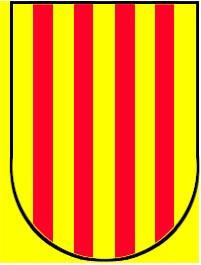
Aragon arms |
|
|
The red-and-yellow
of Aragon were prominent in the flag of the
Kingdom of Sicily, although
some historians claim that the colors were
Sicilia's
answer to the ill-fated reign of the Angevins,
and that the colors stood for the two cities
most prominent in the rebellion against the
French - red for Palermo, and yellow for
Corleone. There are conflicting
reports over the use of the 'Trinacria' flag
shown here, and later versions show the colors
reversed. |
|

Flag of
Sicily
1282 - 1816 |
|
|
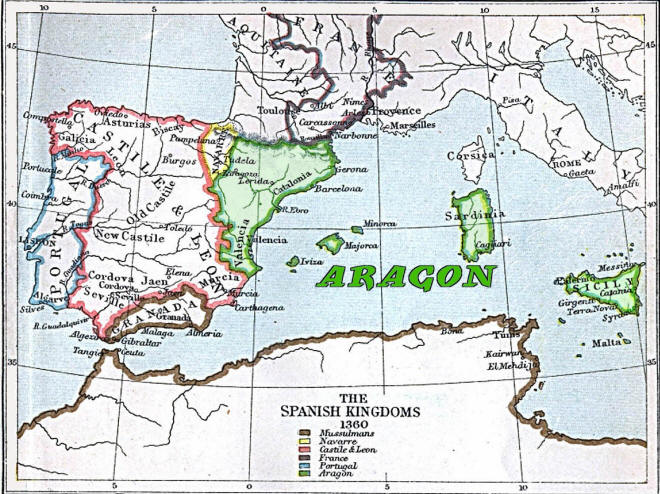 |
|
With
the treaty of Caltabellotta, the rulers
of the mainland Kingdom of Sicily
(Kingdom of Naples), the Angioini descendants of Carlu I, as well
as the pope, Boniface VIII, finally
recognized the Aragonese as rulers of
Sicilia,
in the person of
Federicu II d'Aragona, (Federicu
III di Sicilia) Pietro III's son
and great-grandson of the great
Stupor Mundi, Federicu Secondo. Now
Sicilia
was no longer il Regno that had
once ruled over far-flung territories,
but an island under the authority of
distant kings. It was also now
separated not only physically but
philosophically from mainland Italy and
Naples, which, though still ruled by the
Angioini, was just entering the
golden age of Dante and Giotto.
Thus, as Naples and the mainland moved
toward a renaissance, the 'Kingdom' of
Sicilia
began its sad decline as a remote
Spanish possession. To
differentiate between the 'Kingdom of
Sicily' that was in actuality the Angevin's
peninsular 'Kingdom of Naples', the
island Kingdom of Sicily was called
'il Regno di
Sicilia
di là dal Faro' (the
Kingdom of Sicily beyond the lighthouse
of Messina).
Taken
together, the rule of the Aragonese
(1282 ~ 1492) and of Spain (1492
~ 1860, with brief interruptions)
represents the longest period of
domination by one foreign power over
Sicilia,
other than that of the Romans. At
first, a peaceful
Sicilia
prospered under the Aragonese, although
the often discontented Sicilian nobility
periodically caused unrest.
Federicu II of Aragona reigned until his
death in 1337, but in no way should he
be confused with Federicu II of the Swabians, grandson of Ruggieró
II. Though they were both
descendants of the great Ruggieru, there
was little similarty in the cultural,
social and economic policies of Federicu
II of the Hohenstaufens,
and he of the Aragonese. To
further complicate (or perhaps simplify)
matters, the Aragonese King took the
name Federicu III di Trinacria
(the name Trinacria was a condition of
recognition imposed by the
Angevins of Naples, who still called the
Italic peninsula from Naples south
'Sicily', still claimed rights to
the island of
Sicilia, and commanded
tribute from Federicu III).
Roads and byways in modern
Sicilia with
names like 'Via Federico Secondo'
are named for the Norman/Swabian ruler
of Il Regno, not the
foreign Aragonese king.
On his
coronation in 1296, Federicu III bestowed
the title of Conte di Caltanissetta
to
Pietro Lanza, grandson of the
Chief Justice of the Kingdom. In 1396,
Eleanor of Aragon, descendant of
Lanza, was invested as Contessa di
Caltanissetta. |
|
Most of the castles and medieval palaces
that still remain in
Sicilia
were constructed during Aragonese rule.
The styles of these structures were
sometimes strictly Gothic as in mainland
Europe. However, in
Sicilia
mostly Romanesque styles were favored,
but called 'Gothic' because of
inclusion of some typical Gothic
features. The
Chiaramonte family built one of the
most redoubtable castle-fortresses, the
Castello Manfredonico, in
1391, in Mussomeli, in central
Sicilia.
It included the prototypical Medieval
castle elements: a drawbridge; a
dungeon; a trap door that dispatched
foes into the 'camera delle morte'
(room of death); a torture chamber;
'stumbling blocks' in doorways;
crenellated outer walls for guards and
archers, and so on. It even has a
legend of princesses imprisoned in a
tower room, and a ghostly knight who
haunts the castle still. The only
element lacking is a moat, which was
entirely unnecessary, since the castle
was built on a huge monolithic
outcropping of rock that was virtually unscalable. |
Castello
Manfredonico
Mussomeli |
|
In churches, bas-reliefs and
two-dimensional icons gave way to full
statues. The arts were to some extent
supported by private patrons outside the
church, but
Sicilia under the Aragonese
did not approach its former status under
the Normans. There were few social
advances, and the island's economy was
exploited to feed the coffers of Aragon,
while its nobility did little to support
economic development. There was
virtually no middle class, and the
advances in literacy gained during the
reign of the Altavilla family were lost
or even reversed, and even the barons
were largely illiterate. Social woes
were further deepened in the mid-14th
century by the bubonic plague, which
killed one in three people in cities
like Tràpani and Catania, whose
populations fled to the hills.
|
|
There was underlying conflict between
the Sicilian nobility such as the Houses
of
Chiaramonte, Ventimiglia and
Palazzi, called the 'Latin'
nobles who had ruled
before the onset of the Angioini and the
Aragonese, and those who arrived from
Aragon, the 'Catalan' nobles such as the
lords of Montcada (or
Moncada) of Barcelona,
(originally from Béarn, just north of
Aragon), as well as the House of
Alagona. With the king usually
in faraway mainland Aragon, this
friction was characterized by one noble
House or another attempting to seize
fiefs previously the property of the
defeated Angioini nobles. The mark of a
baron's power was the extent of his
holdings, even if the major portion of
the land was held uncultivated and
unproductive. The result was
a series of disagreements, sometimes
violent, often accompanied by the
degradation or destruction of property,
and exacerbated by frequent bouts of
|
Steri
Palace ~ Palermo |
|
famine or
plague. The Steri
Palace, shown here, was built by the
recalcitrant Chiaramontes in Palermo as
a fortress, but the last of the
Chiaramontes was hung in its courtyard
and it was converted to the residence of
the Spanish Viceroy. |
|
After brief reigns by his sons Peter,
Louis, and Frederick, Federico III was
succeeded by his daughter Maria,
who was underage and yielded control of
Trinacria to her husband Martino,
a noble of Aragon. He took the
name of Martino I di Trinacria (the
Younger) and on his death
his father, Martino King of Aragon took
the name, illogical as it sounds, of
Martino II
di Trinacria (the Elder)! So
Martin the First was succeeded by
his father, Martin the Second.
|
|
The Moncadas were a
powerful family that had
gained favor with
King Giacomo (Jaime,
James) of Aragon
during his war against the
Moors, when during a
scarcity of supplies,
Guglielmo Moncada had
given the king his last seven loaves
of bread. Giacomo gave six of the
loaves to his Barons, and
split one in half to share
with Moncada. This
was memorialized in the coat
of arms of the House of Moncada,
with
six whole loaves, and one
that is halved.
In
1407, the Contea
di (County of)
Caltanissetta, given by Martino the
Younger to Sancho Roiz,
Grand Admiral of the
Kingdom, was traded to
Matteo Moncada ed Alagona.
Included was land that
would become the feudo
(fief) of Serra del Falco.
This marked the
beginning of a series of
exchanges, according to
Giuseppe Testa,
in which the fief was
"lost, sold, and reacquired
in a cycle of sale and
re-purchase without end"
by the noble House of
Moncada, actually over a
period of two centuries. |
|
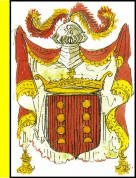
Moncada coat of arms |
|
|
Positive contributions by the Aragonese
included encouragement of foreign
complements, including merchants from
Catalonia (Spain), and from the Italian
mainland, traders from Genoa and
bankers from Venice.
Enclaves of foreigners resulted in
still-extant churches like St.
Joseph of the Neapolitans and
St. George of the Genoans,
both in Palermo. But the
voracious demand for lumber to build
Aragonese ships caused further serious
deforestation of the island for economic
gain by the Chiaramontes and
Ventimiglias.
Martino II ruled until 1410.
He had no children and his rule passed
to his nephew Fernando I (in
Sicilia
called
Ferdinandu Primu). Fernando's son
Alfonso V of Aragon conquered Napoli
in 1442, and that nation was again
politically joined with
Sicilia,
but unlike the glory days of Il Regno,
they were together under the rule of a
foreign king. Corruption
flourished under Alfonso. No crime
was so serious that a pardon could not
be bought; tax-gatherers stole from both
the populace and the king; away from the
coastal cities, peasants existed under
anarchy and near-slavery, subject to
'the law of the strongest'; the barons
held monopolies on grinding wheat,
baking, slaughterhouses, and the wine
and oil presses. As a result of
their mismanagement and avarice,
periodic famines began to occur in what
was once the granary of Europe.
The peasant classes' ties with the
Church were strengthened during this
period, as religious feasts offered them
periodic brief respites, when the the
common man might enjoy the all too rare
music, food and distraction from their
labors.
Aragon and other Iberian states began to
be subsumed into the Kingdom of Spain after several decades of wars,
including the expulsion of the Moors
from Granada; disagreements over
sovereignty; and intermarriage between
Iberian nobles. King Fernando
II of Aragon (grandson of Fernando
I) married Queen
Isabella of Castile in 1469,
and they combined to control essentially
all of Spain, as well as the holdings of
its incorporated kingdoms, which
included Trinacria (Sicilia),
which he ruled as Ferdinandu
Secundu.
At
about this time, Ottoman (Muslim) pressure on the
Balkan country of Albania,
east of the heel of Italy, across the
Adriatic and Ionian Seas, caused
thousands of Orthodox Christian Albanians to flee
to southern Italy and
Sicilia,
rather than convert to Islam. Many
settled in
Sicilia, in towns such as
Piana degli Albanesi (Plain of
the Albanians), Santa Cristina
Gela, Mezzojuso, and
Contessa Entellina. A
dialect of Albanian is still spoken in
some places, and the immigrants' name
for themselves was
Arbëreshë:
for example, their name for Piano degli
Albanesi is
Hora
e Arbëreshëvet
(Town of the Arbëreshë).
The Albanian immigrants were often
called 'Greeks' by the locals, not
referring to their origins, but to their
Greek Orthodox beliefs. By
Fernando II's time, nearly a thousand
Albanian families had settled in
Sicilia,
and a myriad of modern Sicilians are
their descendants. Even hundreds
of years later, whole villages of
Albanians were brought to
Sicilia
to populate and convert rural fiefs into
economic centers for their noble
Sicilian owners (see Marianopoli,
later in this history). |
|
|
|
|
SPAIN
(1492 ~
1713 AD; 1733 ~ 1860
AD),
THE CHURCH,
and the
INQUISITION |
|
In 1492, two world-changing events
were promulgated by Ferdinandu and Isabella. One was the
voyage west and the discovery of America by Cristoforo
Colombo (Cristóbal Colón) of Genoa
(then a part of Spain); the other was the expulsion from Spain (as
well as from Sicilia, also part
of Spain) of all Jews and Muslims who did not convert to Catholicism.
The former turned the interest of Europe away from the
Mediterranean towards the treasures, real or imagined, of the
'New World'; the latter, by rejecting thousands of skilled
merchants, businessmen, scholars and patrons of the arts,
seriously diminished Spain's economic strength and its culture.
The Roman Catholic
Church for centuries had already had a profound impact on
Sicilia, through its
manipulation, approval, disapproval or outright control of the
nobility, from the coronation of Ruggieru II by Pope
Innocent in 1139, to the installation of the Angioini
as Sicilian rulers by Pope Clement IV, to the feudal
custom of granting high religious posts to those secondary sons
and daughters of nobles who did not inherit noble titles. The
Church was a major owner of property, paid no taxes, and its
hierarchy was generally exempt from the law. Bishoprics
often had their own armies and enforced their privileges by
strength of arms. Until the late nineteenth century, the
Church and the state were intertwined and jointly responsible
for sanctioning marriages, recording births, and other vital
statistics. Generally, what was sanctioned by the Church
was deemed legal and proper by the state.
The Spanish
Inquisition, an organization meant to ferret out
heretics, was a creature of Spain, not of the Vatican. It was a quasi-independent organization which owned
property (often stolen from its victims, the Jews and Muslims it
killed or expelled). It imposed its own law, and existed as an
entity until the 18th century. The signature
activity of the Inquisition was the 'auto da
fé' or 'act of faith',
supposedly a penance by heretics. The term became
synonymous with what was imposed after the recanting: burning
the heretic at the stake. The Inquisition not only
murdered or expelled the Jews and Muslims, it suppressed progressive philosophies,
change, and foreign intercourse, bad and good.
Some portions of Europe, including the Italian peninsula,
permitted some non-Catholics to remain, although under severe
restrictions. But in
Sicilia, the pogroms were so
devastating that Jews and Muslims essentially disappeared. Along
with them, as lamented by Sicilian author
Vincenzo Salerno, went the things that had made the island a
unique, 'multicultural land of
ancient Greek philosophers,
Arab sages,
Norman monarchs and
Swabian emperors -- disappeared with the waning of the Middle
Ages, never to return.' The legacy of Spain in
Sicilia is a sad one.
Many of the persecuted remained, as 'secret Jews', called
Marrani in Sicilian and
B'nei Anusim
(children of the coerced ones) in Hebrew.
The first
auto da
fé
in Sicily took place in Palermo in June 1511, when the
Inquisitors executed nine Sicilian
B'nei Anusim
for secretly practicing Judaism.
If discovered, Marrani
were killed, but remnants of their culture still exist in
Sicilia, and have begun to be
re-invigorated.
B'nei Anusim refers
not only to the children of the 'secret Jews', but to all the
subsequent descendants.
Salerno says that
artists, philosophers and
writers during the height of power of the Inquisition could not openly challenge accepted
conservative aesthetics or thought, and 'the
island was becoming isolated from the world's great social,
scientific and artistic developments.' While the Protestant
countries of northwestern Europe moved towards increasingly
higher levels of literacy, more efficient industrialization,
higher per capita income and ever greater individual rights,
Spain and its holdings, including Italy and
Sicilia, suffocated under the
legacy of the Inquisition, reflected in the Roman Catholic
Church's intolerance of progressive social change through the
late 1800's. By then, the Church was the largest
landholder in Sicilia, with
more property than the king and the richest noble families, such
as the Lanzas and Paternòs.
From 1492
through 1713, Spain's 'ownership' of
Sicilia was uninterrupted. Its kings remained
in Spain or Naples, while Viceroys represented them in
Palermo. To quote
Giuseppe Testa, the role of Sicilia
in those years was 'saziare
l’ingorda lupa della Corte di Spagna':
'to sate the greedy wolf of the Spanish Court'.
|
William Shakespeare lived during this
period, and the English bard wrote his plays
from 1585 through 1613. One-third of
his works were set in one or more of the
many city-states and duchies located in the
Apennine peninsula, and even in Syracuse,
Sicilia.
But NONE were set in "Italy", since as can
be seen from this map covering 1350 through
1600, there was no country called Italy at
that time. |
|
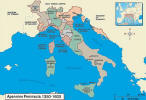 |
|
|
Because of the scorching summer sun, the southern
Apennine peninsula and the island of
Sicilia became
known as the Mezzogiorno region (Mazziurnu,
in Sicilian, meaning 'mid-day').
The coasts of the Mezzogiorno in the 16th and 17th
centuries were infested with pirates; poor land
management led to frequent protracted famines;
cholera epidemics raged; Etna had devastating
eruptions; in Sicilia,
taxes were heaped upon taxes.
In an
attempt at land reform, Sicilian nobles were
encouraged to cultivate their large estates (latifundi)
which in many cases had lain fallow for generations.
They were issued permits (Licenzia per
popolare) to found new centers
(università) of population.
For each permit, of course, a fee was paid
to Spain. In the 17th century, eighty new
towns (comune) were established in
Sicilia.
One of them was
Serradifalco, licensed in 1640 to Donna
Maria Ventimiglia, grandmother and guardian of
Barone Francesco Grifeo, of the family that
had, in 1617, purchased the fief of Serra del
Falco from the Moncadas.
[Note: In Medieval
documents, the family name was mis-spelled 'Graffeo',
but the correct spelling is Grifeo, as
confirmed by the griffin on the family coat of
arms.] In 1652,
the fief and the town were acquired in turn by
Doctor Leonardo Lo Faso of a noble Lombard
(northern peninsular) family which had settled in
Palermo. In 1666, King Filippo of
Aragon, Sicilia,
Jerusalem, Portugal, Hungary, etc., etc. conferred
the title Duca (Duke) on Lo Faso and
Ducato (Duchy) on Serra del Falco. |
|

Grifeo arms

Lo Faso arms |
|
The latifundi were so vast and undeveloped
that the population of new centers, or università,
was characterized as colonization, much as
other nations colonized foreign lands. Often
driven by the Spanish Court's need of permit fees,
and by the local Barons' desire for profit, this
feudalism had numerous negative aspects.
However, the enterprise that formed the soul of
today's Sicilian interior was this colonization of
long-fallow estates with towns and all their
appurtenances: mills, jails, shops, and so on; and
populated by their necessary inhabitants: cobblers,
carpenters, barbers, doctors and artisans, along
with sharecroppers and laborers.
Another bright spot in Sicilia's
Spanish history was Antonio Veneziano
(1543-1593) of Monreale, just south of
Palermo. He was called the 'Sicilian Plutarch'
for his earthy poetry combining the Sicilian,
Italian, and Spanish languages. He was once
captured by pirates and jailed in Spain, where he
was a cellmate of Cervantes, who praised his
collection of poetry entitled 'Celia'.
But during the Spanish reign, Sicilian nobles
became more and more corrupt. Society was
exploited for the gain of the nobles: the Church and
the king effectively acted as one to keep the
general population ignorant, and illiteracy was the
norm. This sad legacy extended beyond the rule
of Spain, until after the 'unification' of the
Apennine peninsula, when even in 1870, less than twenty
percent of the population could read and write.
Thousands of
civil records from the early 1800's bear
the clerk's statement: 'Letto
il presente atto agli intervenuti, si e da me
sottoscritto solamente, avendo detto il dichiarante
e testimonii di non sapere scrivere' or
'This record was read to those in attendance,
but is signed only by me, the declarant and the
witnesses having said they don't know how to write'.
This illiteracy has led to confusion in countless
descendants of Sicilians, about the 'proper'
spelling of their family surnames. Because the
majority of people were unable to read or write,
their names appeared on official documents with
whatever spelling the clerk felt was correct.
Thus, for example, a man's surname might be recorded
as Puleri on the birth record of his
son Diego, and as Pileri two years
later on his son Carmelo's record, filed by a
different clerk. This could result in the two
brothers and their descendants having
differently-spelled surnames!
If the common man managed to satisfy the demands of
the Church and the Barons, he still might be struck
down by the Inquisition because a neighbor coveting
his property or desiring revenge might bear false
witness against him and have him condemned as a
heretic.
The greed and corruption of the nobility during the
long Spanish domination of the island led to
contempt for authority by the common folk, which in
many ways is still reflected today. Many say that a
true middle class never evolved in
Sicilia until after
WWII. Under the feudal system, which lasted
legally until 1812 and much longer in all but name, large farms (latifundi)
and forests were controlled by a few powerful noble
families, while the property, if any, of commoners was
restricted to ownership of a house, a small plot
of land, and household animals. There was no universal system
of civil or criminal courts, nor due process of law.
Instead, along with their titles of prince, baron,
etc., the king granted the feudal lords civil and
criminal jurisdiction over their fiefs, as well as
rights referred to as 'misto e mero'
(complex and simple); which gave them the power of life and death over their
subjects. To enforce this power, the lords
employed compagnie d'armi, small
private armies, to enforce their authority.
The brutal punishments doled out by these hired
thugs, and their closed, 'honored' associations,
resulted in their evolution into 'families' that
imposed 'respect' (that is, fear) in order to control
Sicilia's cattle
and pasturelands, slaughterhouses, fruit
plantations, market gardens and ports: in other
words, the so-called 'mafia'.
During its dominance over
Sicilia, Spain was usually preoccupied
with 'bigger fish': its conquest, settling
and colonization of the Americas; Pacific
exploration and conquest of the Philippines; naval
conflict with Great Britain, and so on.
Periodically some families of Spanish craftsmen,
soldiers and farmers settled in
Sicilia, in addition to Spanish
titled nobility, but most of the island's population
was derived from local stock that was present when the Aragonese took over. Though there are claims
of noble titles descended from those early
proto-Spanish lords, the Spanish surnames carried by
some modern Sicilian families are generally those of
ancestors who arrived from Spain after 1500, or
simply adoption by commoners of the surnames of
their lords or barons.
Sovereignty of Spain passed among rulers of various
noble houses of Europe including the Habsburgs
(present-day Germany) from 1516-1700, and thereafter
the Borboni
(Bourbons) (present-day France). At
various times, there were again references to the
'Kingdom of Sicily', but these were simply names
of the holdings of foreign kings, and did not
constitute an independent nation. These kings
went into the history books with a plethora of
confusing names, because of the varied languages of
the nations they ruled, and the complicated rules of
succession of each. Thus the man referred to
in English texts as Bourbon Charles III, King
of Spain was called, in Spanish, Carlos III de
Borbón, and in Sicilian was Carlu
VII Borbonese, Re di
Napoli ed Sicilia
(Charles VII, Bourbon King of Naples and Sicily);
his son, Ferdinand IV (Fernando IV) of Spain
became Ferdinandu III
di Sicilia.
I have tried to use the names and suffixes as they
were used in Sicilia. |
|
|
|
SAVOY (1713-1720) |
|
In the early 1700 Bourbon King Charles III died without an heir.
In the wake of his death, much of Europe became involved in wars
over the disposition of Sicilia.
The House of Savoy (Savoia),
a Duchy of western Europe (present-day France) had eventually
sided with the victors, so in 1713 under the Treaty of Utrecht
Sicilia was given to the Duke of Savoy, Victor
Amadeus II. His reign was brief, but reflected a theme
that had continued since Frederick II. Amadeus refused to
be subject to the pope's appointment as papal legate and ruled
that papal decrees would be void in
Sicilia unless approved by him, the king. The
pope excommunicated Sicilian churchmen who supported Amadeus,
and the king imprisoned or exiled those who followed the pope!
Amadeus involved Sicilia in
a war between Spain and Austria (the island's worst war since
ancient times), the end result being that Amadeus exchanged
Sicilia for Sardinia!
During this period, Spain's long-time rival for empire,
Britain, began an association with
Sicilia that would last for centuries.
The Treaty of Utrecht in 1713 had resulted in the
international recognition of Philip V as the King of Spain. Part
of the Treaty's agreement was that Spain ceded
Sicilia
to Savoy, and Sardinia to Austria. Due to its losses, Spain was
deliberately excluded from
the Italian peninsula, Sardinia
and Sicilia
by the Utrecht settlement. [Note:
Modern summaries may state that Spain was excluded from 'Italy'.
Since there was no nation known as Italy at that time, the term
'Italy' refers to the Apennine peninsula, plus Sardinia and
Sicilia.]
The
map
below depicts Sicily in 1717, with the cities and towns that
existed at the time. Some no longer exist, and the names
of some have been changed, but many remain. On this map,
the three
vals
are called
Val di Mazzara,
Val di Noto
and
Val Demone. |
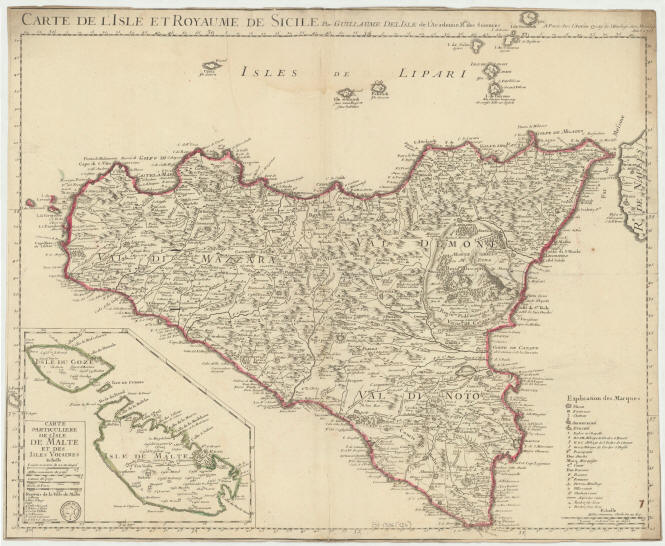 |
|
Spain then tried to regain
Sicilia
and Sardinia, and to place them again under their authority, and
not simply for commercial interests, since
Sicilia
had ceased to be a chief partner for Spanish traders. By
the end of May 1718, five Spanish men of war sailed towards
Barcelona. Approximately two weeks later, Amadeus,
Duke of Savoy, sent a letter to George I, King of
Great Britain.
In the letter he claimed that the Spanish fleet had sailed from
Barcelona to Palermo in
Sicilia,
where they had landed their troops to reclaim Spanish
sovereignty.
Some maintained that it was fully
appropriate for Britain to protect
Sicilia's
neutrality by apprehending the Spanish fleet. By
late July the British Admiral Sir George Byng and his fleet had
arrived in Port Mahon, Minorca, from where they were to sail
towards Naples to intercept the Spanish.
Many argued that it was Spain's
aggression towards
Sicilia
which remained the principal reason for the ensuing war, and
that it was “absolutely necessary” for Britain to intervene. Although
Spain believed it could reclaim
Sicilia
with its new naval power, the British won a decisive victory at
Capo Passero,
the cape at the southeastern point of
Sicilia,
on the 11 th of
August 1718. By the middle of October the first of
Byng's naval squadron sailed homeward. What
was later called the ‘Sicily Crisis' dissolved back into the
‘status quo', a state of affairs which most European powers
tried to maintain.
Amadeus had thus involved Sicilia
in a war (the island's worst since ancient times) among
Britain and Spain, Austria, and the
Ottomans.
When
it became evident that Savoy hadn't the strength to defend as
remote a place as
Sicilia,
Austria had
stepped in and exchanged its
Kingdom of Sardinia for
Sicilia.
Victor Amadeus protested this exchange,
Sicilia
being a rich country of over one million inhabitants and
Sardinia a poor country of a few hundred thousand, but he was
unable to resist his "allies". Spain was finally defeated
in 1720, and the
Treaty of the Hague ratified
the changeover.
Sicilia
belonged to the
Austrian Habsburgs,
who already ruled Naples,
the end result being that in effect Savoy was forced to trade
Sicilia to Austria for
Sardinia! |
|
|
AUSTRIA: THE HABSBURGS (1720-1734) |
|
This period of Sicilian history goes virtually unmentioned by
scholars.
Both
Naples and
Sicilia
were conquered by
a Spanish army during the
War of the Polish Succession in
1734, and
Carlu, Duca di Parma,
a younger son of King Philip V of Spain, was
installed as King of Naples and
Sicilia
in 1735. |
|
|
BOURBON SPAIN (1734-1860) |
|
By 1735, Spain, through Carlu VII,
again had sovereignty over the kingdoms of Naples and
Sicilia, and the island was once again
under the Spanish yoke, ruled by the Bourbons (Borboni).
After Carlu's death in 1759, his eight-year-old son Ferdinandu III
became the Bourbon ruler of the Kingdom of Naples
and Sicily. The regent of the minor
Ferdinandu's reign was
Bernardo Tanucci, who intentionally limited
the boy-kings' education, to reinforce his own
power. This ploy was successful and even in
adulthood, Ferdinandu was content to let Tanucci run
things. In 1768, Ferdinandu married Maria
Carolina of Austria, the sister of France's
Marie Antoinette.
By the marriage
contract, the queen was to have a voice in the
council of state after the birth of her first son,
and she soon availed herself of that power, to which
her husband acceded. She saw to it that
Tanucci was dismissed, after which she was strongly
influenced by the Briton Sir John Acton.
Then, along came Napoleon
Bonaparte. Napoleon, son of minor nobility
originally from
Firenze (Florence), was
born on Corsica, a French holding, as
Nabulione Buonaparte in 1769. Three
years earlier, Michelangelo Alessi, an early
ancestor of Rosa Alessi, had been born to
Calogero and Grazia Alessi in Marianopoli,
a town that had been founded in 1726 by
Baron Lombardo della Scala, near the site of the
ancient Greek town of
Mytistratos.
Ironically, the new town was populated with
colonists from Albania, or as they were
called because of their Orthodox faith,
'Greeks from Ipeiros'. In about 1768,
while Sicilia
was still under Spanish rule,
Gaetano Coniglio, great-grandfather of the
author's father Gaetano Coniglio, was born in
Serradifalco. The late 1700's saw the
emergence of the use of gunpowder in warfare, and
Sicilia's abundance of sulfur made the
island a valuable asset coveted by combatant
nations. Serradifalco was a
sulfur-mining center, and the Coniglios were
early miners there. |
|
It was also under
Bourbon Spain's dominance that the gifted
opera composer
Vincenzo Bellini emerged. He was born in
Catania, Sicilia
in 1801, and raised to young manhood there.
His works, including
Norma,
I
Puritani, and
La Sonnambula are considered among the 'Bel
Canto' period's finest examples of that style of
opera. He is memorialized in Catania's
Museo Belliniano, and his work is honored
more prosaically by the name of a dish popular
throughout Sicilia:
pasta with red sauce and eggplant, called 'pasta
alla Norma'. |
|
|
|
|
After the French revolution, Napoleon Bonaparte
opportunistically rose from First Consul of
the French Republic in 1799, to
Emperor of the French in 1804, and in 1805
he proclaimed himself King of Italy, a minor northern Apennine kingdom which
did not include Naples or
Sicilia.
In 1806, to escape the advance of the Napoleonic
forces, Ferdinandu III and Queen Maria Carolina fled to
British-occupied
Sicilia, becoming
its first monarchs in centuries to actually reside
there. It was
occupied by a military force of the British,
commanded by Lord William Bentinck. Britain
ostensibly supported Bourbon Spanish interests, but its
motivation was, at least in part, its interest
in the island's sulfur and other economic resources
including its vineyards.
At this period in history, there were actually
TWO nations called
Sicilia, with one faction claiming
sovereignty in the north at Naples, and the other in
the south, at Palermo. Both variously were
called "The Kingdom of Sicily" or "The Kingdom of
the Two Sicilies". Northerners
commonly referred to the
island
of Sicily as Sicilia
al di là del faro (Sicily
beyond the lighthouse)
and to the rest of the kingdom on the southern boot
of the Apennine peninsula (where the capital city of
Naples was located)
as Sicilia
al di qua del faro (Sicily
on this side of the lighthouse).
The reference was to the
lighthouse at Messina on the peninsular side of the
strait between the "toe of the boot" and Sicily.
This north-centric way
of considering the mainland as "here" and Sicily as
"there"
continues to this day.
To lessen the confusion, modern-day scholars simply
refer to the former Sicilian kingdom of the north as
"the Kingdom of Naples".
Napoleon
installed his brother Giuseppe Bonaparte
as the king of Naples. Ferdinandu attempted to reign from
Palermo as king of Sicilia,
but Bentinck replaced him with his son Francescu
as regent, and had Maria Carolina exiled to Austria.
In 1808, Napoleon named his brother-in-law
Joachim Murat "King of Naples and Sicily",
but the island was never under his control. In 1812, influenced by Bentinck,
Sicilia's parliament, often ineffective, passed a constitution
modeled on Britain's, calling for a house of Peers,
a house of Commons, an English-style jury
system and the abolition of feudalism. |
|
But in 1814 Napoleon abdicated and was exiled
to Elba. In 1815 the British left
Sicilia. The Bourbon Ferdinandu
regained power, suppressed the constitution and
returned to Naples. After 1816, he reigned
from there as Ferdinandu I, Re delle Due
Sicilie (Ferdinand I, King of the Two Sicilies).
So he went from being Ferdinand IV of Spain,
to Ferdinand III of Naples and Sicily, to
Ferdindand I of the Two Sicilies!
The boundaries were still essentially as they had
been in Roger's Il Regno, but rather than
being ruled by a native king from Palermo, the
island was now considered on the fringes of the
nation ruled by Bourbon Spain, from a
distant city. |
|
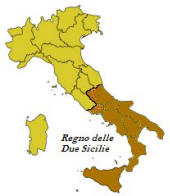 |
|
During Ferdinandu's brief stay in Sicilia,
Bentinck had forced the abolition of the feudal system there.
This, however, should not be viewed as an action
sympathetic towards the peasants, but rather, an
indication of the greed of the absolutist monarchy;
a way to take the large estates out of the hands of
the barons, and give the king more control over
them. The changes in the structure of Sicilian
society after this action were to weaken the
nobility but encourage speculators and opportunists
to replace them as landowners. The peasants in
many cases simply went from working for the barons
to working for the ruthless entrepreneurs (some of
them former peasants) who took over the latifundi.
This further muddied the complex concept of 'mafia'. The struggles to achieve an advantage over the
nobles, or the church, or the king; to obtain what
one could by force if necessary; to achieve 'honor';
all may have led many an otherwise honest but
powerless peasant to seek aid from or even to aspire
to inclusion in the 'mafia'.
A positive influence by Napoleon
was that when he took over much of Europe at the
beginning of the nineteenth century, he
instituted a system of law, the Napoleonic Code,
which included the
recording of civil vital statistics. This system
introduced new, standard formats for the recording of births,
marriages, and deaths, similar to the forms used for
the registration of these events to this day, and in
many cases more detailed than modern records.
Even though Napoleon never entered or held sway over
the island of
Sicilia, its Bourbon masters adopted
the so-called 'Napoleonic format' for these
records, which now are a boon to
genealogists and to descendants of Sicilians
searching for
information
about their ancestors. Generally
speaking, as a researcher moves from north to south
through Italian towns, the amount and quality of
civil records improve. Those of Sicilia
are the best, and civil records in fact are
relatively uniform
in format throughout all of the towns of the former
Kingdom of Sicily, from the provinces
of Naples and Abruzzo in the north to Messina and
Palermo provinces on the island itself, where the
greatest uniformity exists.
In 1816,
Sicilia was
once more officially merged with Naples as the Kingdom of
the Two Sicilies but that year
saw the first of the island's three 'revolts' in
the early 19th century. The most serious
occurred in 1848, a year
in which numerous insurrections took place across Europe.
On January 12, 1848 in
Sicilia, the
nobles tried to reinstate the 1812 constitution,
including the principles of representative democracy
and the centrality of Parliament in the government
of the state. At that time the Two
Sicilies were ruled by Ferdinandu I's grandson,
Ferdinandu II. After the Sicilian
revolt, the island functioned as an independent
state for 16 months. A former admiral
and senator, activist Ruggieru Sèttimu, Prince
of Castelnuovo
(1778-1863), was the effective head of state during
this brief period of Sicilian independence. The name Ruggieru Sèttimu
literally
means 'Roger the Seventh', but although he was a
nobleman, it is not clear if he was a descendant of Gran Conte Ruggieru.
Regardless,
Ferdinandu II ruthlessly bombarded the rebel
strongholds of Palermo and Messina, earning him the
nickname 'Re Bomba' (King Bomb).
By force, the army of
the Borboni re-established control of the island in 1849,
and Ruggieru Sèttimu went into exile in Malta.
After Ferdinandu
II's death in 1859, his son Francescu II was the Bourbon King of the Two Sicilies
~ until 1860, and the coming of Garibaldi. |
|
|
|
GARIBALDI:
PIEDMONT~SARDINIA
(1860 AD ~
1861 AD) |
|
Giuseppe Garibaldi played a major role in the
Risorgimento, the consolidation of states called the 'Unification of Italy'.
I find it virtually impossible to conceptualize that
role without referring to a map of the regions
involved. Below is such a map, showing
political boundaries in 1860. Note that there
was no nation or state called 'Italy',
and the largest nation in the region was the
Kingdom of the Two Sicilies, which traced its
roots to 1130 AD, as Roger II's Kingdom of Sicily. |
|
|
... |
|
The
region included the following states: |
|
| |
|
.. |
the Kingdom of Piedmont-Sardinia (called
simply Piemonte),
comprised of the island of Sardinia, and
on the mainland in the Alps foothills, with the
former duchies of
Piemonte (Piedmont), and Genoa, as
well as Savoia (Savoy); and also Nizza
(Nice), which had long been claimed by France. The
Kingdom of Piedmont-Sardinia had become a
nation separate from
France after Napoleon's abdication, and had been
ruled by King Vittorio Emanuele II of
the House of Savoy since 1849;. |
.. |
| |
Lombardia (Lombardy) and
Venetia, two Austrian holdings in the north; |
|
| |
several small northern duchies, south of Lombardy,
as well as; |
|
|
|
the state of Tuscania (Tuscany); |
|
| |
the 'Papal States' of Romagna,
Marche (the Marches) and
Umbria;
|
|
| |
the Papal State of Latium and the city of
Roma (Rome); and |
|
| |
the Kingdom of the Two Sicilies ruled by
King Francesco II of the Bourbon Spanish
Empire.
|
|
| |
|
|
|
In the fifth century, various barbarian rulers
(including the
Ostrogoths and
the
Lombards) in
the north of the Italian peninsula called their
state the 'Kingdom of Italy', and that usage was
continued by various rulers of the general region
until the seventeenth century. None of those
'kingdoms of Italy' included any significant
territory south of Rome. Between 1648 and 1802, there was no nation
or kingdom named Italy. 'Italy'
referred not to a country, but to the area south of
the Alps, and the unique boot-like peninsula
extending into the Mediterranean. In 1802,
Napoleon had renamed the Cisalpine Republic,
an area including the northern states of
Lombardia and Romagna, and called
it the Italian Republic. After he
assumed the title of Emperor of the French in 1805,
he changed the Italian Republic to the Kingdom of
Italy and acted as its king. When
he abdicated in 1814, the Austrian Empire
took over much of the kingdom, and most of the
remainder reverted to the church. Once
again, there was no such nation as 'Italy'.
Giuseppe Garibaldi was born in 1807 in Nizza
(NEE-tsa) (Nice), a region of
Piedmont-Sardinia which had been claimed by France
in 1793. He had had a checkered career prior
to his involvement in the Resorgimento. In
1859, after adventures in Russia, Tunisia and South
America, he was appointed as a
Piedmont-Sardinian major-general in the war with
Austria. Garibaldi formed a volunteer unit named the
Hunters of the Alps
and with them won victories over the Austrians at
Varese, Como,
and elsewhere. One outcome of the war that
displeased Garibaldi was that his home city of Nizza
was surrendered to the French, in return for crucial
military assistance.
Then, in April, 1860, there were popular
uprisings in Palermo and Messina, in reaction to the absolute
monarchist policies of the Borboni of Spain in
Sicilia.
Garibaldi pounced on this opportunity and invaded
Sicilia with a
force of only a thousand men (i Mille, 'the
Thousand') known also as the
Camicie rosse
(Red Shirts). After early
victories, he declared himself dictator of
Sicilia in the
name of
Vittorio Emanuele II 'of Italy', and, joined by
many local dissidents, who with his troops were
called 'Garibaldini', went on to
capture Palermo and Messina. Garibaldi then
crossed the Straits of Messina to Reggio and
went on to conquer Naples and set the stage for the
formation of a new nation. In October 1860 Garibaldi
met Vittorio Emanuele at Teano, north of Naples.
He presented Emanuele with
Sicilia and Naples, proclaimed him 'King
of Italy', and retired. Thus, Garibaldi relinquished
his hopes for a republic, for the sake of Italian
unity under a monarchy. Garibaldi was lionized
by some
in Sicilia,
which was freed by him from Bourbon rule. But in the
end, Sicilia remained the 'possession' of other nations:
first Piedmont-Sardinia and then Italy. There
are indications that many Sicilians supported
Garibaldi because they believed he would institute a
republic (as was his desire) but were unhappy with
his subsequent capitulation to the monarchy. |
|
By 1861, the supporters of Vittorio Emanuele
II
had defeated or absorbed Lombardy, Venetia,
the northern duchies, Tuscany, and the Papal
States, except Latium (Rome). Savoia
and Nizza were ceded to the French Empire.
Including Garibaldi's 'gift' of the
Mezzogiorno, there was a 'unified' Regno d'Italia
(Kingdom of Italy) with
Vittorio Emanuele II as king. Latium
was added in 1870, excluding
Vatican City in Rome. The small
eastern nation of San Marino remained
independent. Trento and Trieste
were annexed after the First World War.
Sicilia
had been the victim of deforestation,
exploitation, neglect, forced illiteracy of
the masses and willful illiteracy of the
baronial class, 'brigandage' or banditry in the
interior, economic decline and a host of
other natural, social and political ills.
Joining a 'unified' Italy did not improve
local conditions. The legacy of
Spain's failed stewardship was manifested in
many ways, including 'inbreeding' which
exacerbated the prevalence of genetic
diseases, not only among
commoners, |
|
.
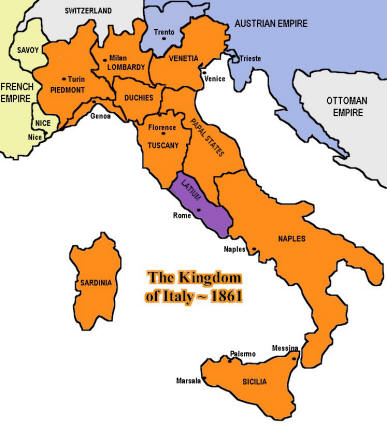 . . |
|
but in the
nobility as well. Spain's harsh rule
also fostered the clannishness and mistrust of
authority and strangers that characterizes
many Sicilians to this day. With
unification,
Sicilia went from the rule of a
Bourbon king to the rule of a
Savoy king. New class distinctions began to
evolve, spawning conditions which would
hinder the island's development for
generations. |
|
|
|
|
ITALY
(1861 AD to
1922 AD) ~ HOUSE OF SAVOY |
|
Garibaldi was unhappy with the exclusion of Rome and the
Papal States from the new, unified Italy. He raised a
troop to attack and take over Rome, but was opposed
at Aspromonte, on the mainland, by forces of the new
Kingdom of Italy, which he had actually helped create.
He refused to fire on them, but nevertheless was himself
shot, and his dream failed. After he recovered, he
retired to Caprera, his small private island off
Sardinia. There, after several other forays into
European conflicts and politics, he died in 1882. As
for Sicilia, from the
first days of unification, there were signs of unrest there.
Rather than enfranchising the local populace, 'the
North', as the mainland is called, sent military
forces, police officials and public functionaries to
Sicilia to fill important
posts. Rather than a partner that had contributed
greatly to the unification, Sicilia
was instead treated as a conquered nation.
A grievance that sparked revolt was compulsory military
service, which had not existed even under Spanish rule.
The king was a Sabaudu (a Savoyan, of the House of Savoy),
and the Italian government was referred to as 'Sabaudu' or
'Piemontese' (Piedmontese). The youth of the
commoners were conscripted to fight for the Piemontese
government on war fronts far to the north from
Sicilia,
while the nobility and privileged classes were allowed to
purchase exemptions for their sons. Many peasants were
sent off while their fields lay fallow and their families
had no means of support. On New Year's Day in 1862, a
crowd in Castellammare del Golfo in Trapani
province attacked the Italian National Guard and killed the
commandant and others, with cries of 'Out with the Savoy
(Vittorio Emanuele)!', 'Down with the mercenaries
(the Garibaldini)!', and 'Long live the Republic!'.
Guards and soldiers at Calatafimi and Alcamo
in Trapani were beaten and chased by rebels. Two days
later, Sabaudu riflemen landed and put down the insurgents,
killing hundreds, including some non-combatant women and
children as well as priests.
Alfonso Maria Cerrati, who described the revolt,
claims that such incidents were not reported, but rather
'covered up' by the government.
Into this mix
came Sicilia's greatest
author-playwright, Luigi Pirandello, born in Caos,
near Girgenti (Agrigento) in 1867.
He was the son of wealthy parents who had supported
Garibaldi against the Borboni, but were disillusioned by the
realities of unification. Pirandello's works,
especially the dramas written in his native Sicilian, echoed
that climate of disillusion, eventually earning him the
Nobel Prize for Literature. A near-contemporary,
Giuseppe Tomasi di
Lampedusa of
Palermo, wrote 'Il Gattopardo' ('The Leopard'),
which related the life of a fictional Sicilian noble
during and after the Risorgimento. 'The Leopard' was
acclaimed as the Sicilian 'Gone With the Wind', and
was the basis of an award-winning 1963 motion picture
starring Burt Lancaster and Claudia Cardinale.
The
period following the Risorgimento was marked by massive emigration from the
Mazziurnu (southern Italy and
Sicilia). Some of the
reasons for this efflux are explained by
Nicola Colella, who writes: |
| |
'The Italian government was dominated by
northerners, and southerners were hurt by high
taxes and high protective tariffs on northern
industrial goods. Additionally, much of southern
Italy's problems can be attributed to its lack
of coal and iron ore which was needed by
industry; extreme scarcity of cultivable land,
soil erosion, deforestation, and overpopulation.
For the North, a higher level of industrialism
meant less poverty and agricultural
difficulties. On top of all that, several
natural disasters rocked southern Italy during
the early 20th century: Mt. Vesuvius erupted
burying an entire town near Naples; Mt. Etna's
eruption; and the 1908 earthquake and tidal wave
that swept through the Straits of Messina, which
killed more than 100,000 people in the city of
Messina alone.' |
|
|
A long, extensive guerrilla campaign
(1861-1871) against unification took
place throughout the southern Italian
peninsula, and in
Sicily. The new Italian government
responded with martial law and ferocious military
repression. Sicily (and southern Italy)
were ruled under martial law for many
years, and were ravaged by the Italian
army that summarily executed thousands
of people, made tens of thousands
prisoners, destroyed villages, and
deported people. The resulting collapse of
the Sicilian economy was further
worsened by the discovery of sulfur in
America's Texas and Louisiana, which
began less labor-intensive mechanical
mining of the mineral by the turn of the
century.
At about
this time, numerous
Mutual Aid Societies or
Società
were formed by miners, field hands, and
other workers with mutual interests.
These societies contributed in part to
the formation of the Fasci dei
Lavoratori (Cohorts of Workers),
which promulgated socialist concepts
among the commoners, who had never had
the right (nor enough organization) to
strike. In
1894, labor agitation by the radical
Fasci Siciliani again led to the imposition of
martial law in
Sicilia. While the word "fasci"
is the root of the word "fascism",
the later Fascist movement
in Italy had only the word in common.
Although the
Fasci Siciliani existed as political
entities only in 1893 and 1894, the combination of
repression by the north, poverty, and
social and political unrest led to an unprecedented wave
of emigration from
Sicilia.
In 1913, the year my father
Gaetano Coniglio
emigrated to America, he was one of over
146,000 others, the largest-ever
single-year Sicilian emigration,
comprising almost seventeen per cent of
the total population of the Kingdom of
Italy.
|
|
This is a history of Sicilia,
not of America, but it must be noted that during this period
about four and a half million Italians emigrated to the
United States, from a country with only about 14 million
people. Over three and a half million of them were
from the Mazziiurnu region, the former
Kingdom of the Two Sicilies! Unable to earn a
living in southern Italy or Sicilia, many became migratory laborers.
|
|
In the period just prior to 1900, nearly eighty percent of
Italian immigrants were men in their teens and twenties, who
planned to work, save, and eventually return to their
homeland. In fact, only twenty to thirty percent of
these immigrants permanently returned to Italy.
Whether they ever planned to return or not, the fact remains
that millions of young Sicilian men (as did many from other
lands) left their fathers, mothers, and siblings, often
never to see them again, to travel thousands of miles under
severe conditions to a foreign land. And often
those who decided to remain in America were later joined by
their wives: teenage girls with babes in arms, who sailed in the fetid
holds of steamers plying waters infested with warships and
hostile submarines. |
Rosa Alessi Coniglio, age 21, and her son
Gaetano Coniglio,
11 months, sailed on the steamship 'Patria'
from Sicily to Ellis Island, from November 28 through
December 14, 1914. They traveled in "steerage" with
1,848 other souls. |
|
It has been said that during this period a 'criminal
element' also emigrated, forming the basis for the 'American
Mafia'. However, it is plausible to assume that for
many honest workers and peasant farmers, the growth of the
'mafia' in Sicilia was
just one more reason to leave. Those who remained
were subject to conflicting social forces. Most Church
holdings, in all of Italy and
Sicilia, including schools, were confiscated by the Piemontese government.
There were strong anti-clerical feelings among the
populace because of long-standing abuse of power by the
church, but these feelings were conflicted with support of
Church customs which had provided them with snatches of
happiness during town religious festi, or
feast days.
During
this period, marriages performed by the Church were not
recognized as legal by the state. Thus, a couple
married in church received its blessings and the moral right
to cohabit, but unless they were also married in a civil
ceremony, their union was illegitimate, as would be their
children. Couples would marry in church, and later
that day, or on the next day, would visit the town's offices
to have a civil marriage performed and legally recorded,
legitimizing any heirs.
Schools were closed for long
periods during the transfer from Church authority, and illiteracy became
even more widespread. Important new industries gradually
emerged in the North, but not in
Sicilia, where a majority of the greatest
resources, the vast estates and the sulfur mines, were still
owned by the aristocracy and exploited for their
own gain. Many contadini, or peasant,
dirt farming sharecroppers, scratched out a meager
existence on the depleted land, paying the 'noble'
landowners rent, forced to purchase equipment and supplies
from them, and then to share half the land's produce. Those who
could not rent or own land turned to work as
sulfur miners, or zolfatai, but their economic
lot was even worse than the contadini, with a sulfur miner
earning the equivalent of about $1.50 for a day's labor,
from before dawn, until after dusk.
Officials
and law officers from the north found themselves among a
people they considered boorish and ignorant, notwithstanding
the fact that if there had been no Sicilian uprisings, there
would have been no Resorigmento, and no Kingdom of Italy.
The northerners scorned those who spoke
Sicilian, erroneously considered by them to be not a true, history-filled language,
but a corrupt 'dialect' of the 'refined'
Italian spoken in the north. Conditioned
by centuries of repression by foreigners, Sicilians were
mistrustful of the Italian National Police, or
carabinieri, most of whom were from northern
Italy. The 'old
ways', of protecting one's self and family, of honor, and of
distrust of newcomers or strangers were deeply bred.
Omertà, or 'manhood'
and the silence that accompanied it were a code of honor.
Sicilians did not inform the carabinieri of wrongs committed
against them. Many brought their complaints to local
'mafia' chiefs, who for a price would adjudicate
disagreements, settle arguments, and even exact vengeance.
Ironically, if the chiefs were aligned with the
authorities, or the perpetrators of the injustice, or if
those paid more, it might be the victim who suffered
the vengeance!
Italy's
involvement in World War I had important impacts on
Sicilia.
Conscription of the flower of Sicilian youth further reduced the worker base and caused more
land to lie fallow, worsening already poor harvests.
Sicilian peasants went to war in the north, often with a few
sons of Sicilian barons as commanders. This led to
some feeling of unity and hope of enfranchisement, if the
workers ever returned safely. However, because the
northern factories must be kept productive, many northern
youths were allowed to remain civilians, manning the
factories, while poor Sicilians saw more and more of their
fellows ordered into the trenches of war. The end of
the costly, mostly inconclusive war brought more social
unrest and calls for reform in the north as well as the
south.
Amid the turmoil of the late nineteenth and early twentieth centuries, some
existing Sicilian social 'institutions' strengthened, and new ones
grew:
the 'modern'
mafia as well as its competing
Società,
or
Mutual Aid Societies,
and even the socialist Fasci dei Lavoratori were essentially Sicilian in character and developed
locally, while Fascism, which developed in the north
with Mussolini, eventually enveloped
Sicilia as well. It
is also ironic that in the early nineteen-twenties, two forces
came to be that would, in the following years, impact both
Sicilia and the Mafia:
one was Fascism, the other was Salvatore 'Turiddu'
Giuliano, called by some "The Sicilian Robin Hood". |
|
The
mafia's goals and activities were intertwined
with those of the traditional masters of
Sicilia: the church, the
nobility, the government, and the police; and in fact
individual mafiosi were often members of that powerful
quartet. Their interests were mutual. The evidence does not
support the offhand claims by some that Giuliano was a
mafioso. Rather, he appears to have been an
independent
bandit leader
who struggled against the repressive authorities, including
the Mafia and its influential patrons,
for motives that may have been noble, or personal, or both.
|
|
|
ITALY
(1922 AD to
1943 AD) ~ FASCISTS/HOUSE OF SAVOY |
|
Born in northern Italy in 1883,
Benito Mussolini, the self-styled "Il Duce"
(the Leader) began formulating his Fascist credo after WWI, in
Milan. Mussolini's Fascism (as
differentiated from the earlier, socialistic Fasci Siciliani)
called for an authoritarian state which subverted the rights
of individuals to those of the party or the state. It
engendered nationalism through militarism, autocracy and
opposition to liberalism. Mussolini and his henchmen formed
armed groups called Blackshirts or Squadristi,
who enforced their policies by threatening and terrorizing
socialists and communists, while the formal government looked
the other way. By 1921, Mussolini had formed the Italian
National Fascist Party, and been elected to the nation's
Chamber of Deputies.
Though
Italy was a monarchy under the Savoy king Vittore Emanuele
II, its government was run by a Prime Minister, at the
time Luigi Facta. In 1922, Mussolini led a coup
d'etat against Facta and was declared by the king as the
Prime Minister of Italy. With threats and
force, Mussolini then had himself elected dictator, and the
effective head of Italy, though the puppet Savoy monarchy
remained to rubber-stamp his policies. Initially, he even
had support from Sicilian quarters, where the barons as well as
the mafiosi sought relief from the monarchy's excesses.
Mussolini soon recognized the Mafia as a threat to his own
domination of Sicilia, and
moved to eradicate it. While suppressing the Mafia and
Masonic elements associated with it, Mussolini mollified the
Catholic Church, making it the official church of Italy, and a
partner in his rule, essentially a government agency.
Sicilians, ever wary of government in any form, often resisted
the Church as an entity, while accepting priests as
individuals. Priests and monks had suffered like the
general populace after reunification, with their lands,
churches, schools and monasteries taken by the
northerner-controlled government. Many priests sided
with the populace against the "establishment", which in these
years included both the Fascists and the Church hierarchy.
Sicilians in general did not support Mussolini, a situation not
improved by his failed economic and social policies. And
though Sicilian emigration to the United States fell to a
trickle because of that nation's restrictive limits of the late
1920's, in the early 1930's hundreds of thousands of Sicilians
moved to northern Italy because of its greater
industrial development and opportunity for work.
Foreshadowing Mussolini's eventual liaison with Adolph Hitler,
in 1938 he expelled Sicilia's
few remaining Jews, mostly doctors and educators, further
weakening the island's viability. Other nations withdrew
from contact with Sicilia:
the British curtailed their popular tourist visits, and the
expatriate Sicilians in America greatly reduced the funds they
sent back to their home towns. Eventually, Mussolini drew
closer to Hitler, in philosophy and in fact, annexing
Ethiopia, Libya, and Albania, contributing to
the outbreak of World War II in 1941.
Because of the obvious lack of support from Sicilians, Mussolini
had armed and conscripted few of them. In September, 1942,
the Comitato per l'Indipendenza della Sicilia (CIS)
(Committee for the Independence of Sicily) was
formed, with a variety of sympathizers including socialists,
centrists, and right-wing aristocrats, as well as criminal
elements.
Although the Allied
(British and American) invasion
of Sicilia in July 1943 was
one of the largest military campaigns in history, with over
400,000 men on each side, it was fought mainly by the
Allied forces against the German and northern Italian
troops. Sicilians, anxious to be rid of Mussolini and
Hitler, were essentially non-combatant observers. As had
been the case for millennia, in many rural towns, life was no
different under Mussolini or during wartime than it was under
other regimes. The peasants worked for the landowners,
'per un piatto di lenticchie' (for a dish of
lentils); that is, 'for peanuts'.
Nonetheless, during the Sicilian campaign
there was significant loss of civilian lives and heavy damage to
infrastructure, concentrated in the larger cities and primarily due to Allied bombing of German supply
lines and depots in Messina, Catania, and
Augusta in the east, and Palermo and Trapani
in the west. Sicilia
fell on August 17, 1943, and formally surrendered with the
Treaty of Siragusa on September 3, as a part of the
Armistice of Cassibile, which forced Italy to
abandon the island, while the U.S. troops still were on the
verge of completing its military occupation.
Once again, Sicilia was
ruled by foreigners, this time the British and the Americans. |
|
|
Allied
Military Government
of
Occupied
Territory ~
(1943 AD to
1944 AD) |
|
The CIS gained support after the armistice, and
demanded the abdication of King Vittore Emmanuele III,
but disbanded in 1944 with the formation of the Movimento
Indipendentista Siciliano (MIS) (Sicilian
Independence Movement). Though the
Allies ostensibly prohibited political activity, they
tolerated the existence of the MIS, which adopted a flag
showing the ancient trinacria, and nine alternating stripes,
one for each Sicilian province, in the colors of
Sicilia, red and yellow. |
_small.jpg) |
|
The MIS developed an armed force known as Esercito
Volontario per l'Indipendenza della Sicilia (EVIS)
(Volunteer Army for the Independence of Sicily). The
popular hero, separatist and bandit Salvatore Giuliano
was an MIS member and flew its flag. Giuliano
became a legend of mid-twentieth century
Sicilia, and his persona is
shrouded in controversy. It seems evident, however,
that like the Mafia, he was a phenomenon whose emergence was
the result of millennia of subjugation of the Sicilian
common man. As it did for so many of his forebears,
his life ended tragically and violently, with even the
nature of his death in question. |
|
|
ITALY
(1944 AD to
1946 AD) ~ HOUSE OF SAVOY |
|
After the end of World War II, in late 1945, EVIS
operations led the Italian central government to send its
troops in Sicily. Following an armed clash with the
Carabinieri (Italian State Police, under control of
northern Italy), Antonio Canepa, head of EVIS,
was murdered. Vittore Emanuele III reigned as King of Italy
(including Sicilia)
until his abdication in April, 1946, when he was replaced
briefly by his son Umberto II. A special
council started working on a special autonomy statute for
Sicilia. It was approved
by Umberto on May 15, 1946. Umberto stepped down on
June 2, 1946, when the modern Republic of Italy was
formed. |
|
|
REPUBLIC OF
ITALY
(1946 AD to
1948 AD) |
|
Although Sicilia was
part of the Italian Republic, it was not until February 2,
1948 that its status as the Regione Autonoma Siciliana
(Siclian Autonomous Region) of Italy was
finally approved by the Italian parliament . The
MIS was not well-supported in the 1946 and 1948 general
and regional elections. |
|
|
SICILIAN AUTONOMOUS
REGION (REGIONE AUTONOMA SICILIANA)
(1948 to the
Present) |
|
This period of the history of
Sicilia is as contentious and violent as its
past, and it will take the author some time to sort fact
from fiction.
But even in 2015, the Italian parliament recognizes a need
to protect and enhance every possible minority language that
is spoken within its national territory, BUT IT EXCLUDES
the SICILIAN
Language, which is spoken by over 10 million people (5.6
million in Sicily, and then in central-southern Calabria and
Salento, as well as an unknown number of emigrants or
descendants of immigrants from geographical areas where the
Sicilian native speakers, particularly those who moved in
the past centuries; in the US, Canada, Australia, Argentina,
Belgium, Germany and southern France.) Steadfast
Sicilians suggest that this is because, as usual, Italy does
not even consider Sicily as part of its territory!
Sicilian patriots to this day bemoan the fact that there is
no official jurisdiction called Sicilia,
but rather only a 'Sicilian
Region'. The island, however, retains the
name, and the loyalty of its expatriate sons:
Sicilia, Sicilia,
tu si la patria mia! |
|
(UNDER
CONSTRUCTION, more to come)
|
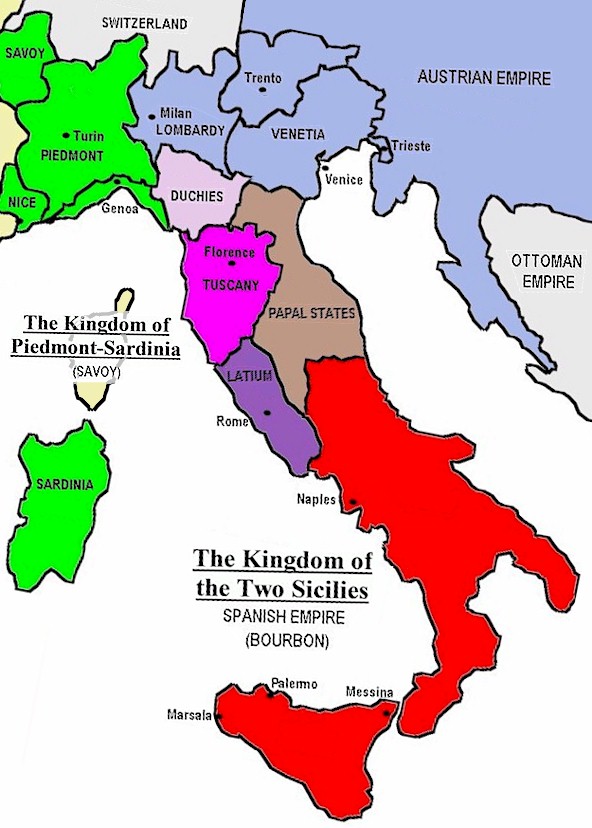
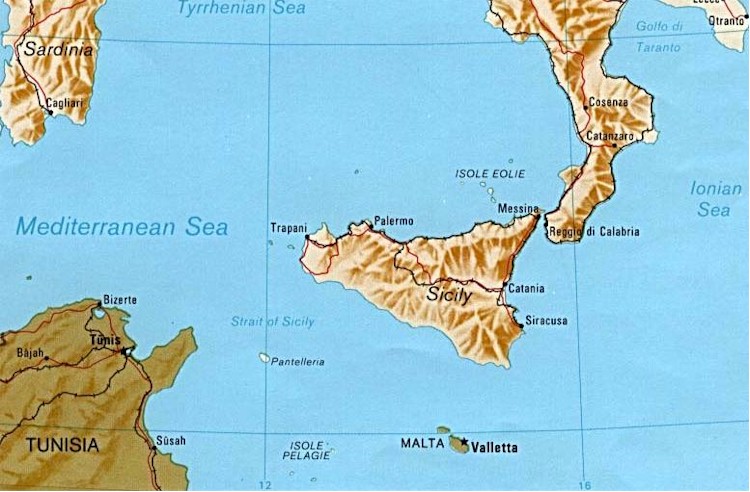
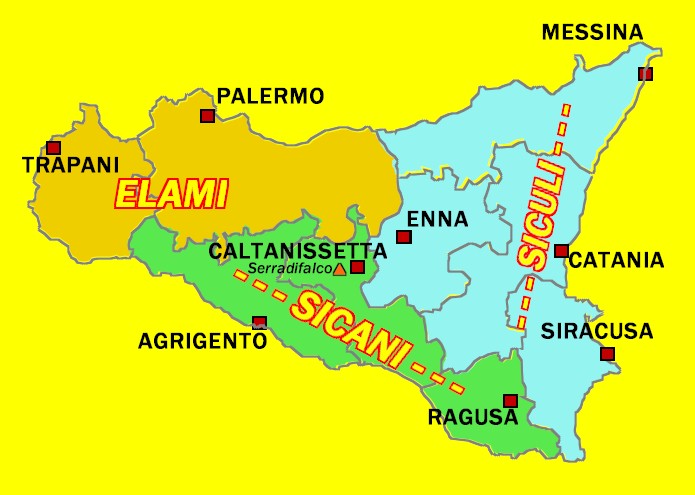
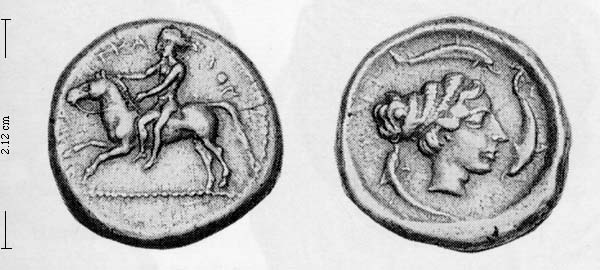
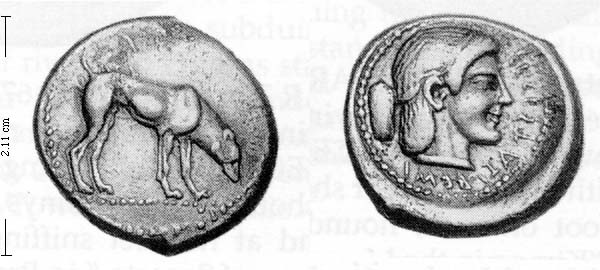
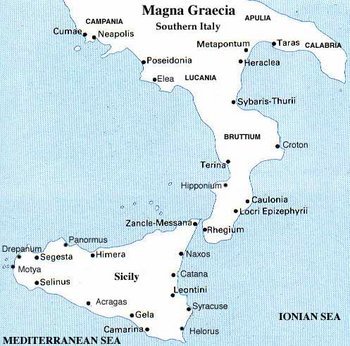
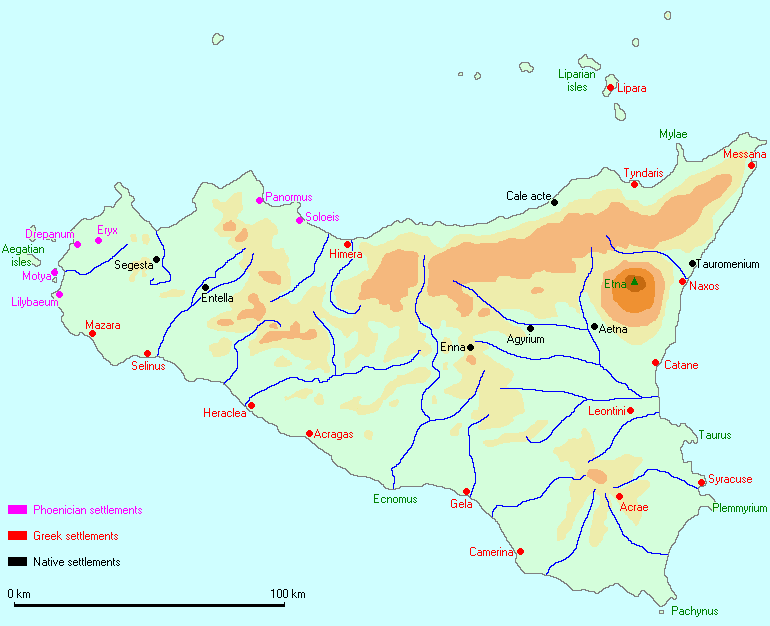
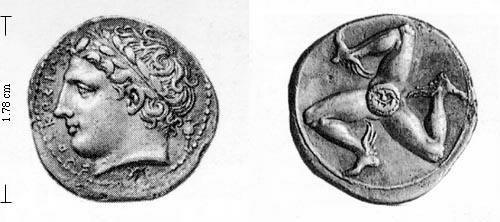
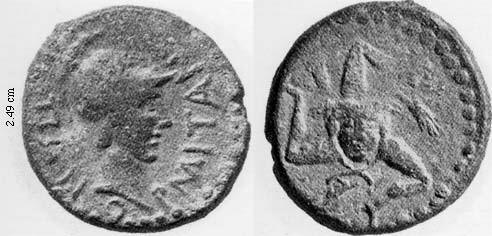
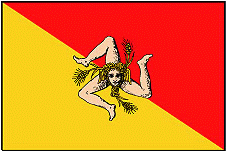
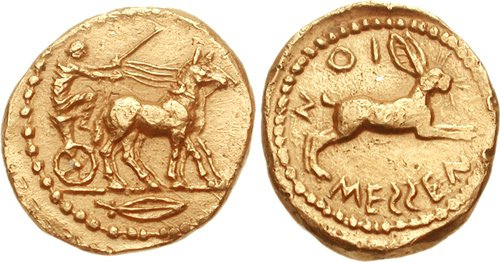
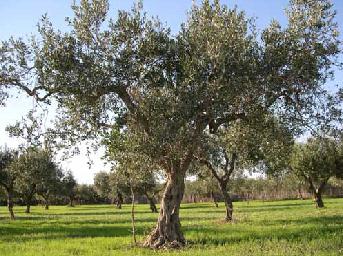
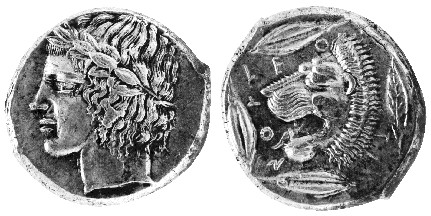
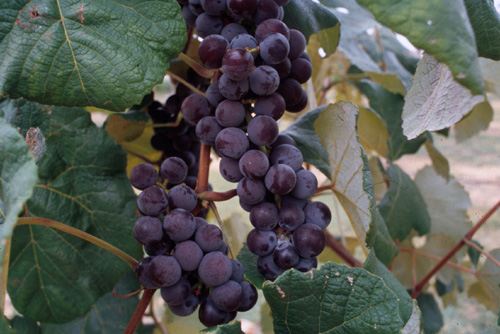
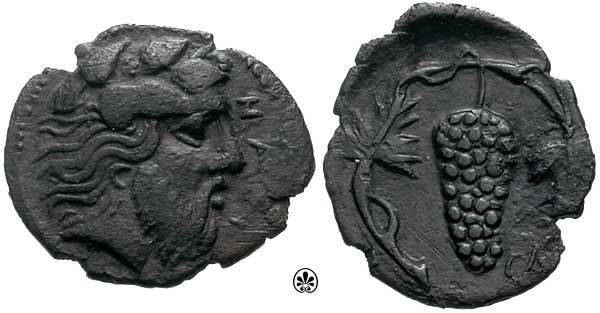
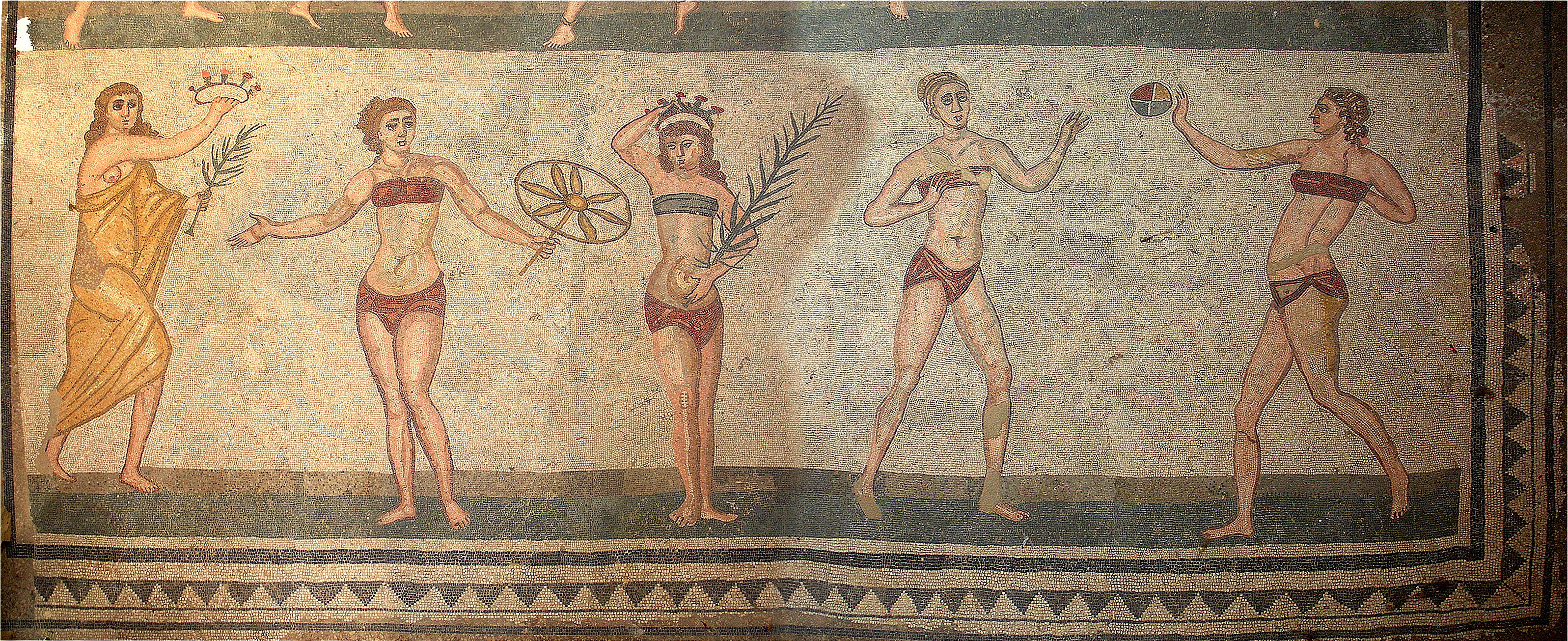
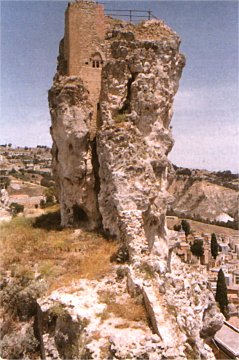
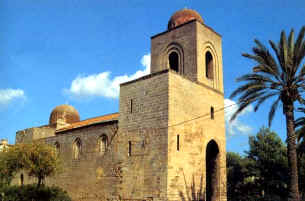
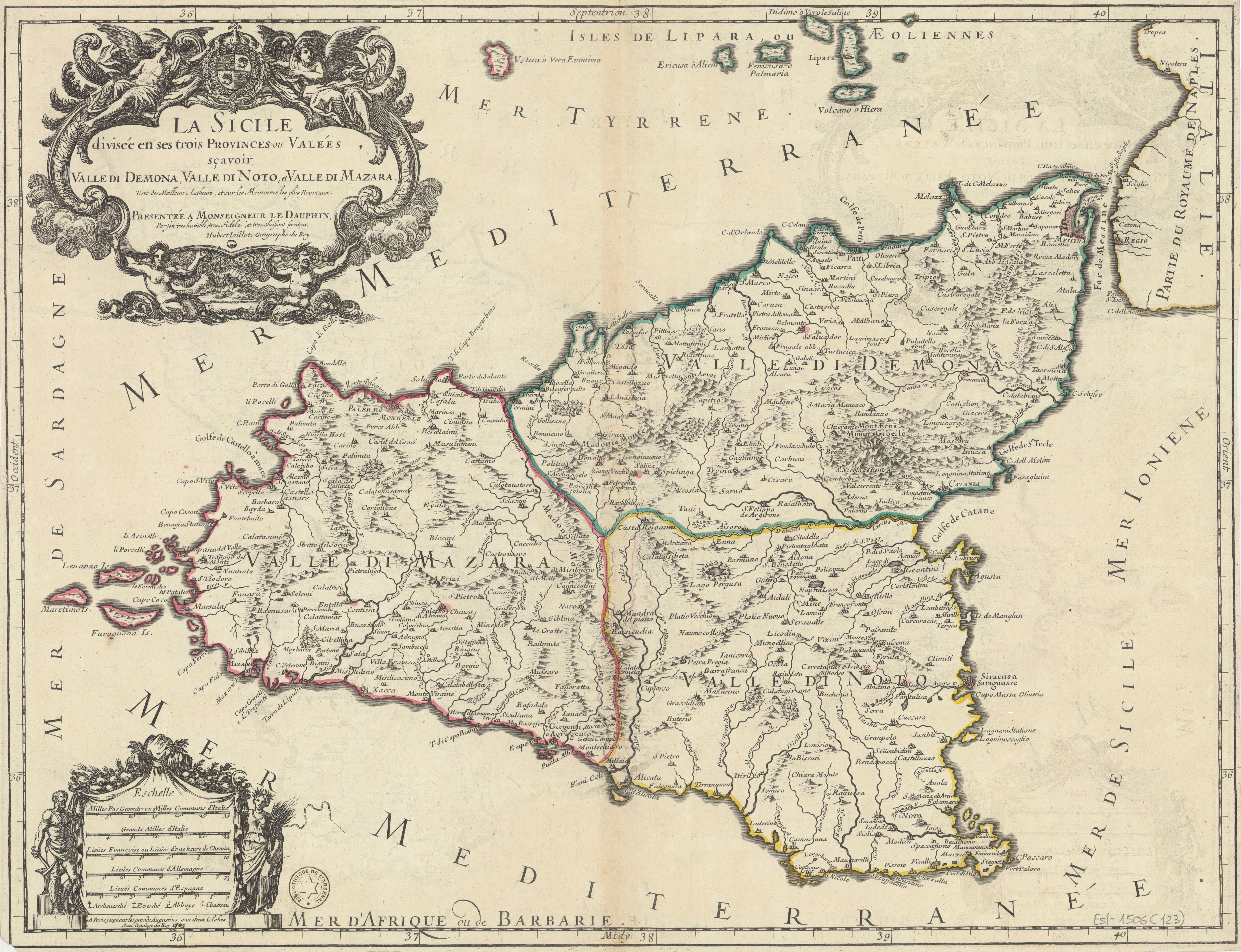
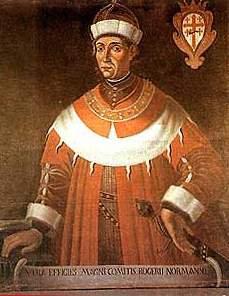
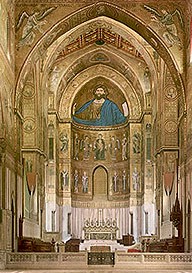
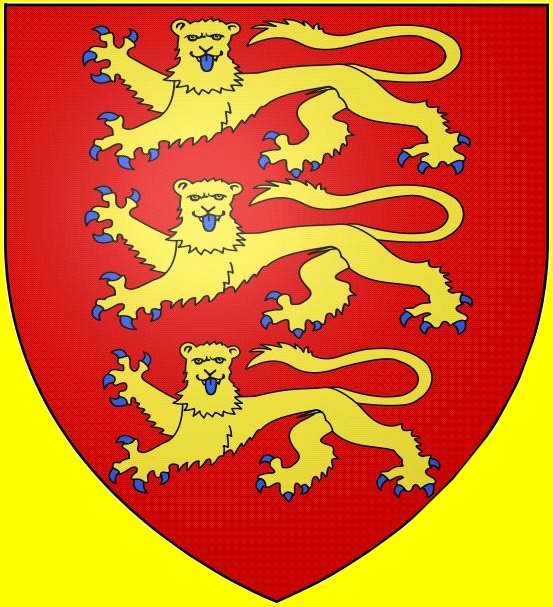
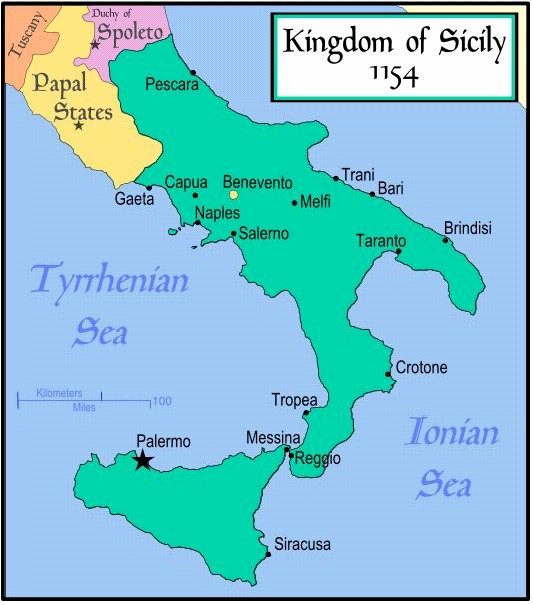
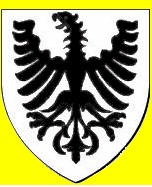
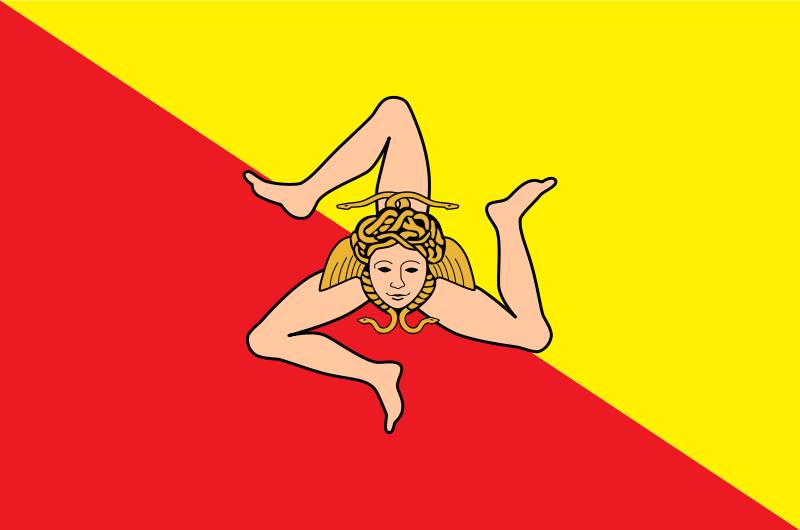
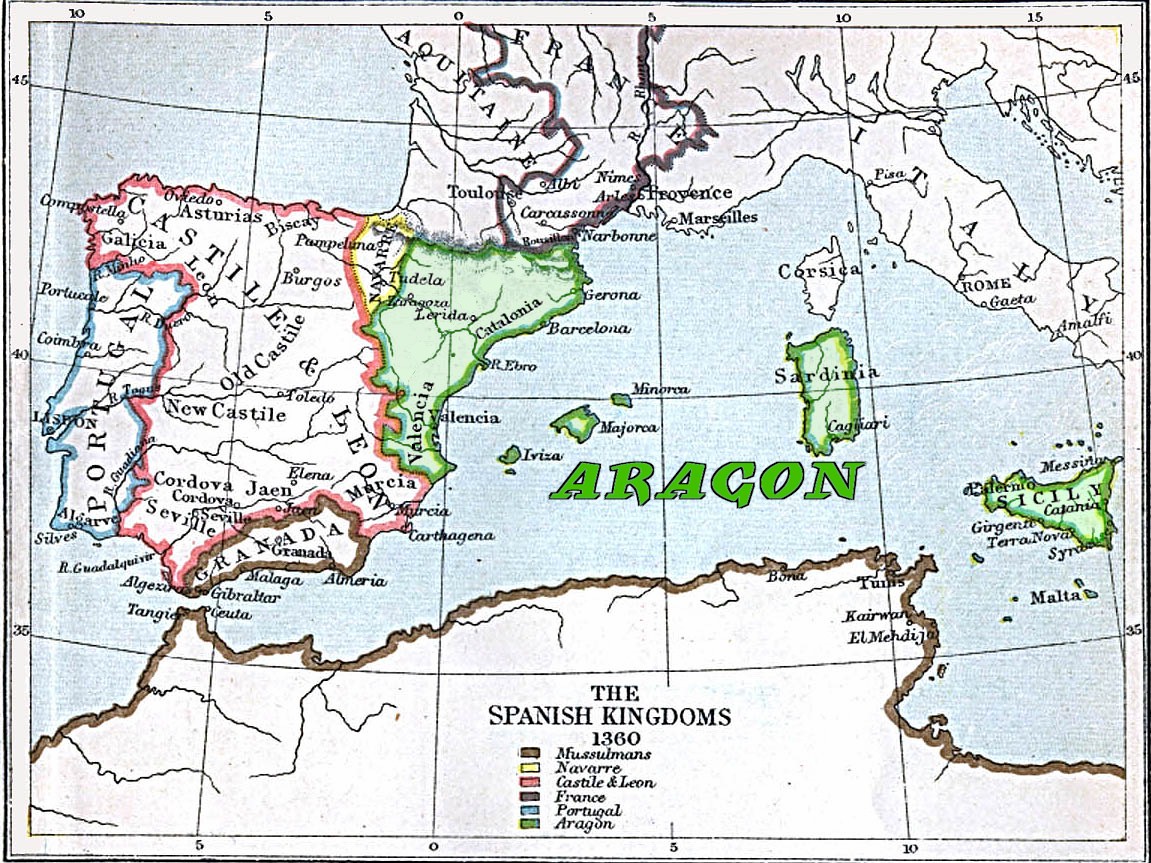
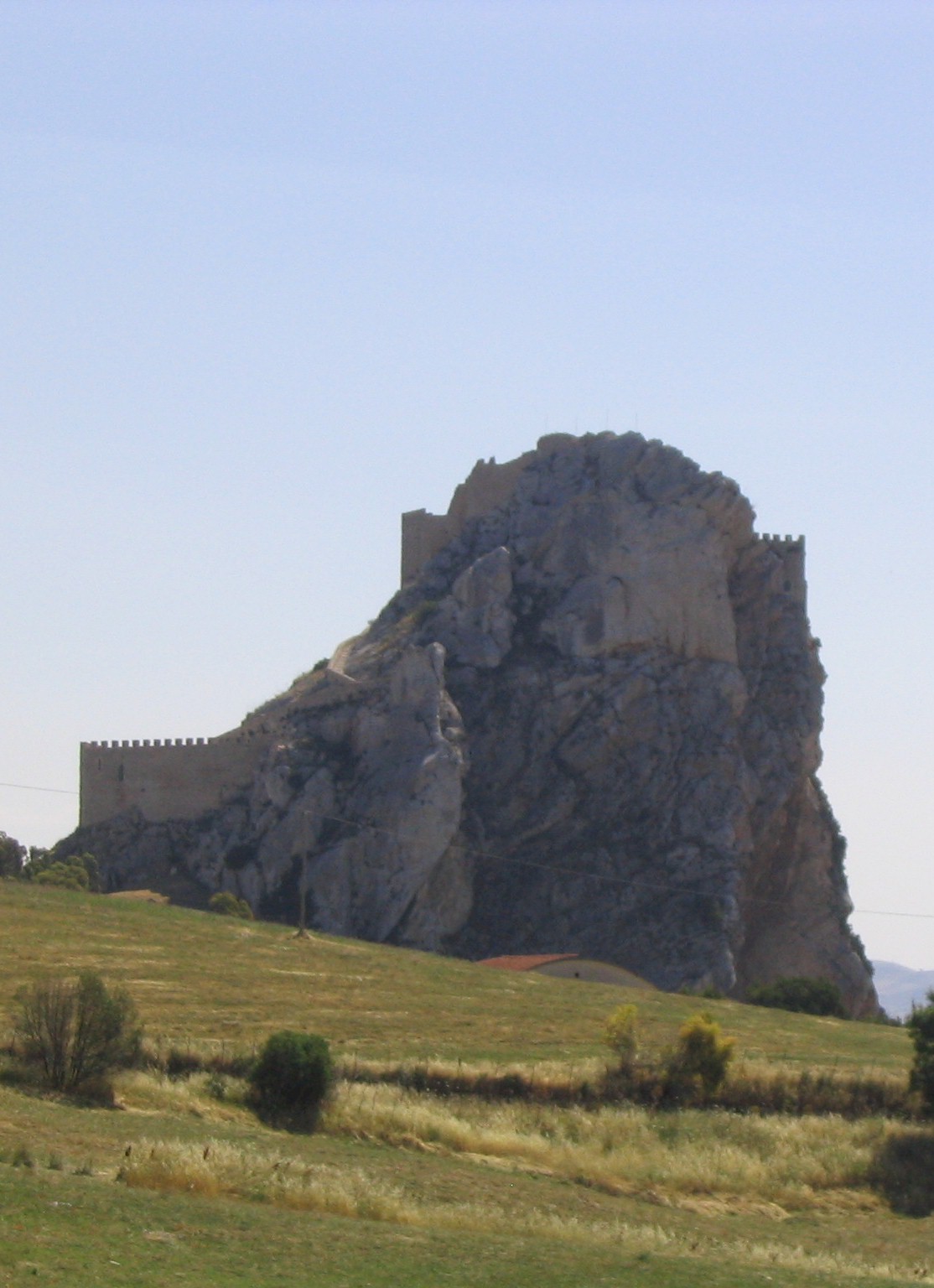
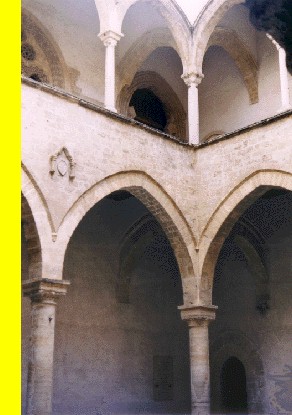
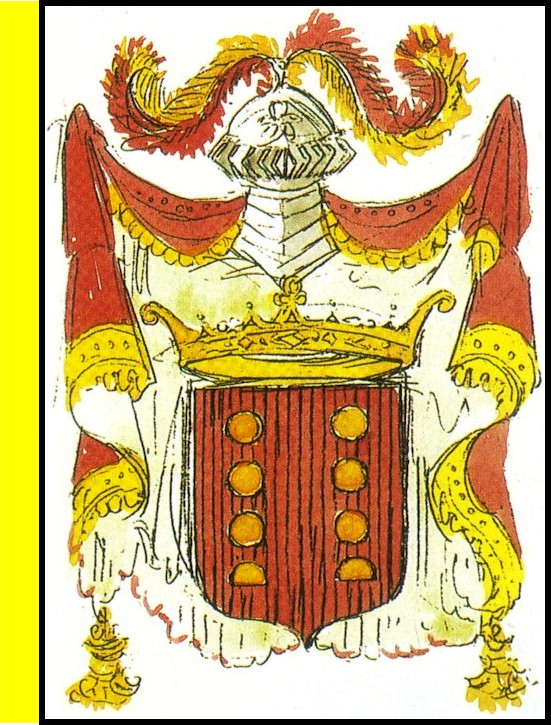
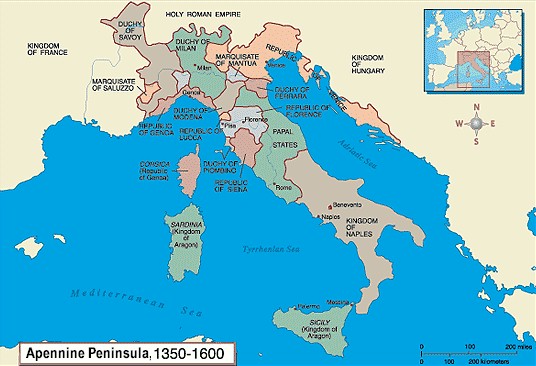
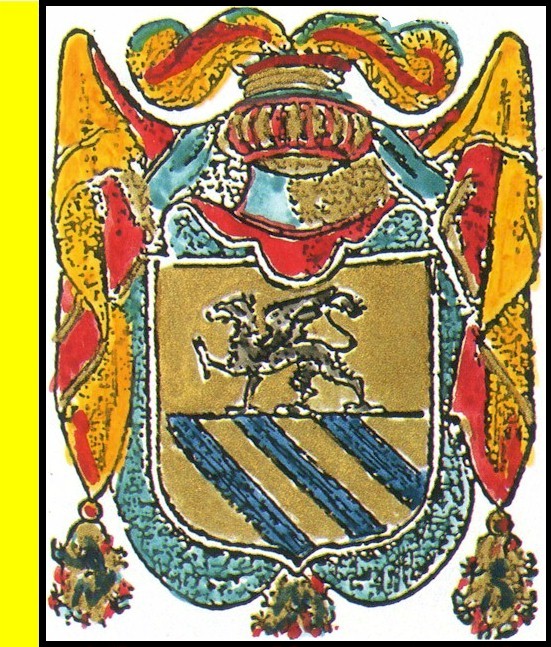
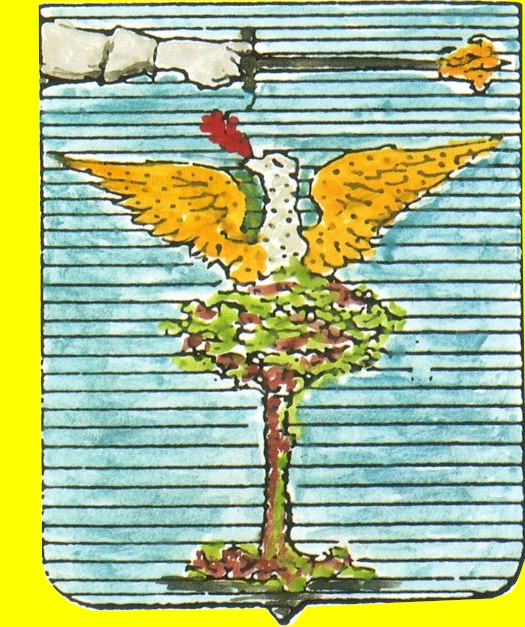
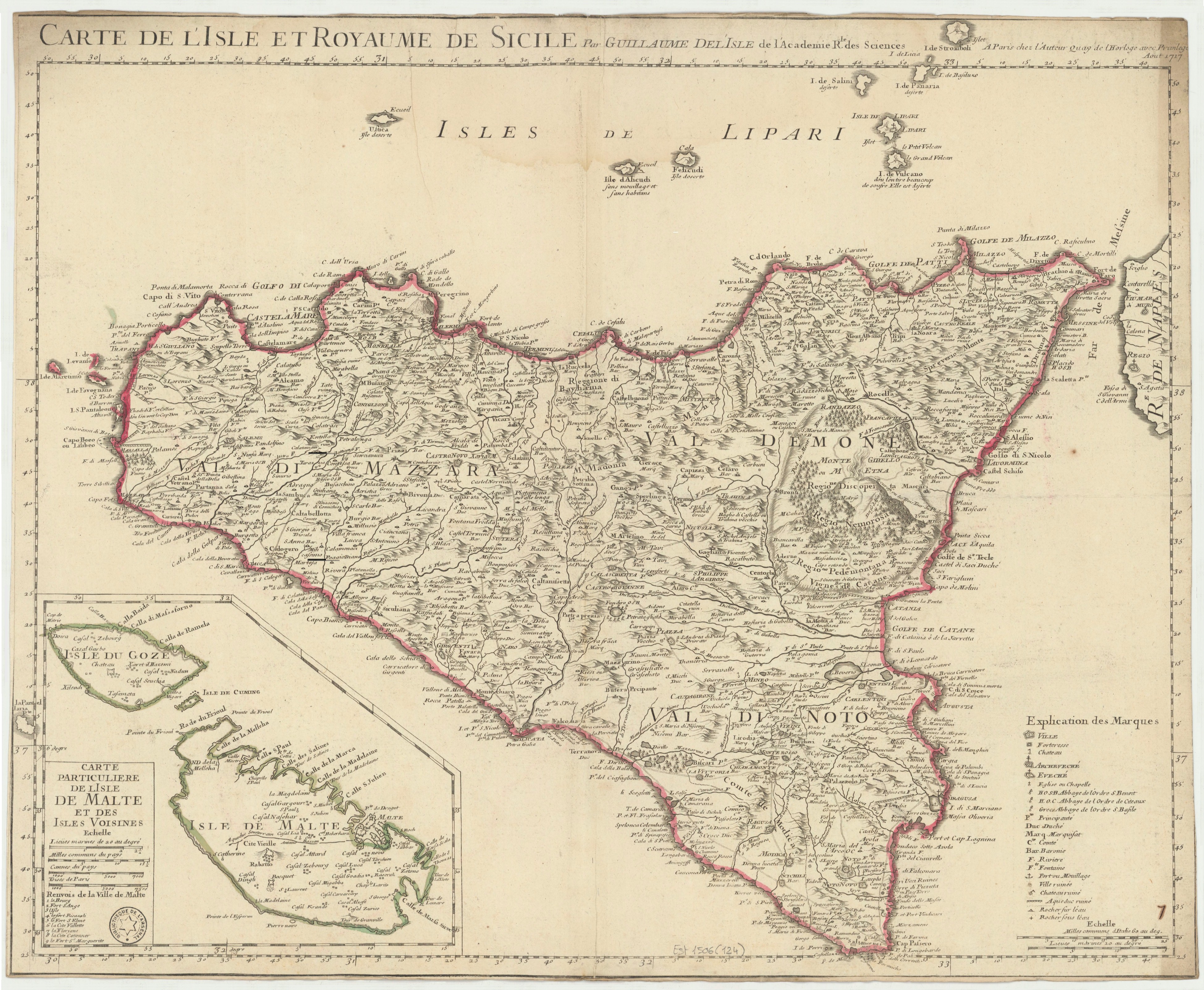
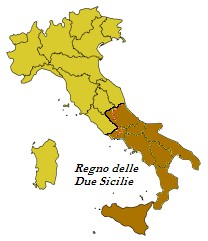
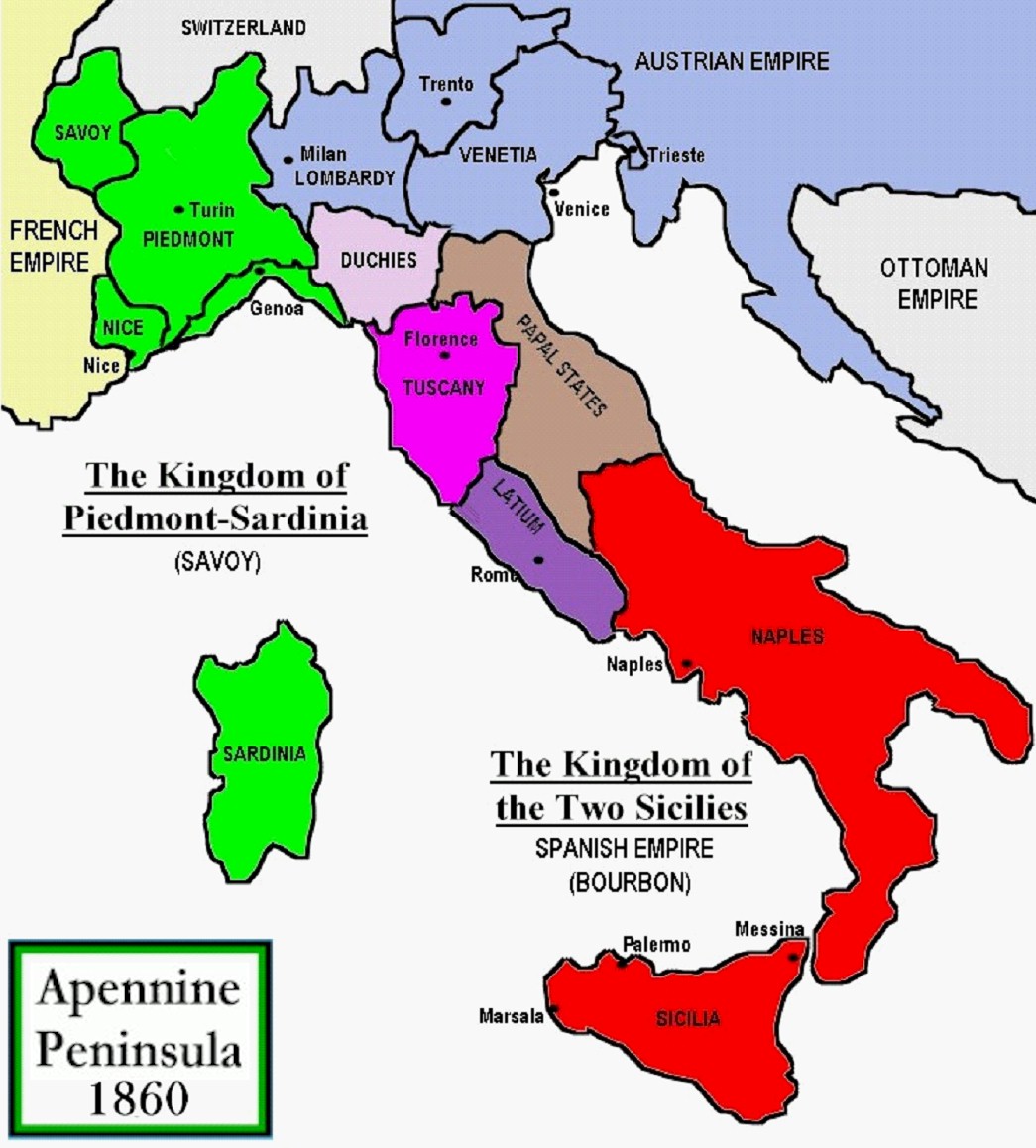
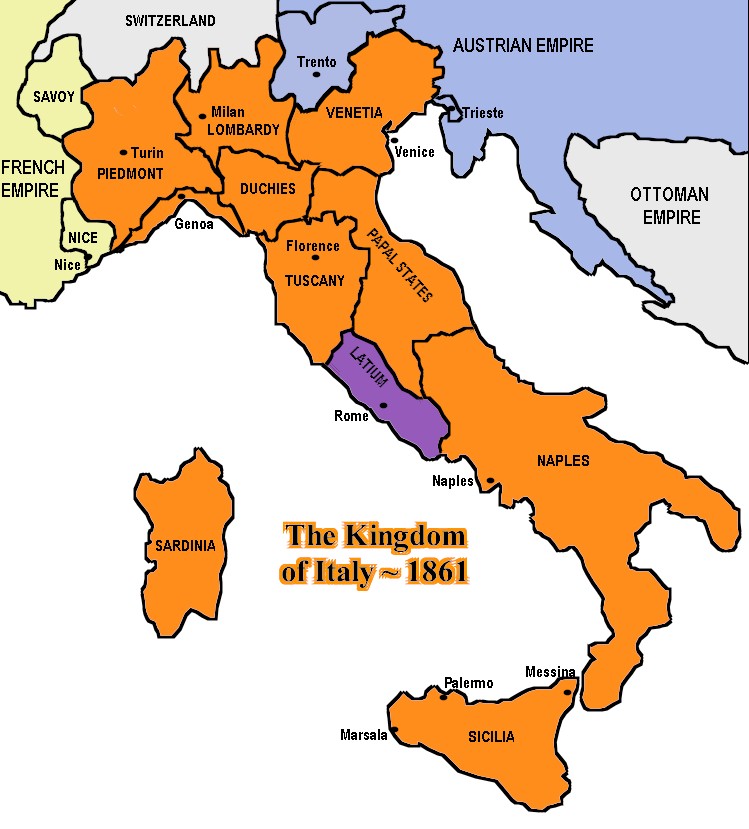
.jpg)